
Part of an ongoing series of 29Secrets stories, taking a deep dive into the history of legendary beauty products and iconic fashion moments…
By Christopher Turner
In fashion history, where names become myth and stitches tell stories, few figures command the reverence of Gianni Versace, the founder of the Italian fashion house Versace. He was more than just another Italian couturier; he was a cultural icon whose influence ultimately extended beyond the world of fashion: a man who was friends with everyone who was anyone, including Madonna, Elton John and Diana, Princess of Wales.
It’s hard to separate “Gianni Versace” the man from “Versace” the brand. To say that Gianni changed the fashion landscape forever is an understatement. A visionary designer, he redefined luxury fashion with his bold, flamboyant designs. In fact, his designs – especially the Medusa head of the Versace brand logo – became synonymous with the glamorous, maximalist lifestyle of the 1980s and 1990s. He orchestrated a whole new visual language of glamour in that era: it was bold, it was unapologetically sensual…it was Versace.
Tragically, Gianni was at the height of his career when serial killer Andrew Cunanan fatally shot him on July 15, 1997, on the steps of Gianni’s Miami Beach mansion, Casa Casuarina. His murder still sends tremors through the fashion world. Following his death, Vogue editor-in-chief Anna Wintour stated in an interview, “He had enormous love for life. He adored what he did and he surrounded himself with people he loved to be with.” She also described him as a marketing genius, saying, “Gianni understood the importance of fashion as a global package. He was the first to introduce superstars on the runway, he was the first to bring the celebrities into the front rows, he was the first to use the rock stars and the actresses in his advertising campaigns.”
Almost three decades after his tragic murder, Gianni remains a defining symbol of a very specific time in fashion history, a designer whose creations spoke the language of power, freedom and glorious excess. Here’s the story of the man behind the brand.
From Reggio to the runway
Giovanni Maria Versace was born on December 2, 1946, in Reggio Calabria, a sun-soaked city at the toe of Italy’s boot. The son of an appliance salesman, Antonio, and a seamstress, Francesca, Gianni grew up with a brother, Santo, and two sisters, Donatella and Tina. In 1952 (when Gianni was six and Tina was 12), Tina died as the result of an improperly treated tetanus infection. She had visited a carnival along with her parents and two brothers when she fell and scraped her knee. She contracted tetanus from the fall, which doctors treated with the wrong medicine. Less than 24 hours after the mishap, Tina died, still wearing her party dress.
Donatella, who was born three years after the accident, told The New Yorker in a 2007 interview that “sudden death is frequent in my family.”
Gianni grew up watching his mother work on designs in her boutique in Reggio Calabria. The small atelier served as early training for Gianni – it was there that he learned the rudiments of sewing, pattern-making and the transformative power of clothing…and, at age nine, created his first dress.
When he was in the fifth grade, a teacher caught him sketching Italian stars like Sophia Loren in evening gowns. “My professor called my mother and said, ‘Your son is a sex maniac,’” Gianni recalled to People in 1986. “My mother said, ‘Professor, my son is not a maniac. He just loves fashion and clothes.’”
In 1966, after earning a draftsman’s degree, he began officially working for his mother. But Reggio was provincial, and Gianni, ever the aesthete, hungered for more. So, in 1972, he moved to Milan, where he worked for a number of fashion houses, including Genny, Complice, Mario Valentino and Callaghan, refining his techniques and absorbing the industry’s rhythms.
Before the end of the decade, in 1978, Gianni established his own company, Gianni Versace SpA, with the backing of the Girombellis, an Italian fashion family. His eponymous fashion house became a family affair, with Santo running the financial side of the business while Donatella served as his muse, as well as being a junior designer and vice president.
“I am a bit like Fellini,” Gianni said in 1986. “I like my family around me…. I am a typical Italian. I love the clan.”
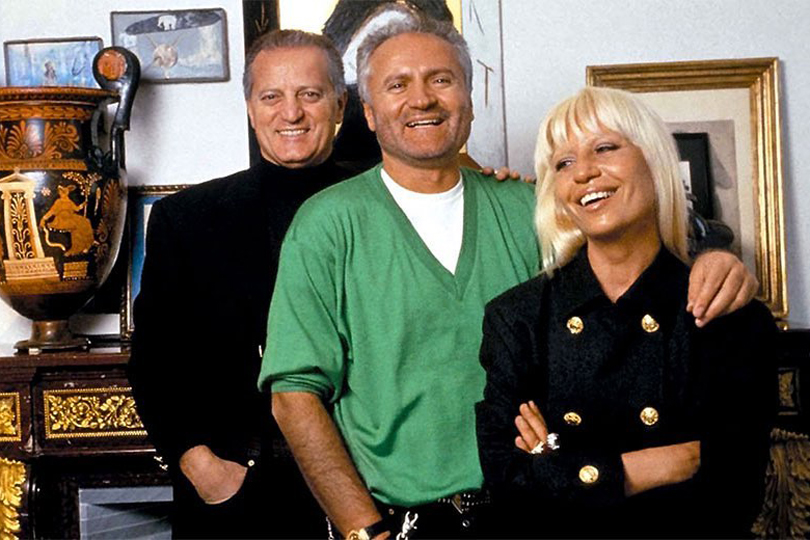
Gianni presented his first ready-to-wear fashion show on March 28, 1978, at the Palazzo Della Permanente Art Museum of Milan. The clothes in the womenswear collection were nothing short of electric: chainmail gowns, sculptural leather, and vibrant prints lifted from classical art and pop imagery.
That same year, Gianni opened his first Gianni Versace boutique on Via della Spiga, the renowned high-end shopping street in Milan’s famous fashion district, the Quadrilatero della Moda.
Fashion’s rock star
With the opening of his Milan boutique, Gianni almost instantly became a sensation throughout Italy and on the international fashion scene. He quickly built a fashion empire by producing ensembles that oozed sensuality and sexuality. While rival Italian fashion house Armani was all about clean lines and corporate restraint, Versace was loud, louche and utterly decadent, with bright prints, vibrant colours and provocative cuts. After all, Gianni believed fashion was not a uniform but a costume for the theatre of life. “I want to dress people who have their own style,” he once said, “not those who want to copy a style.”
And so he did. Gianni famously dressed Madonna, Michael Jackson, Grace Jones, Elizabeth Taylor, Tupac Shakur, Sylvester Stallone and Elton John. But he wasn’t content with merely dressing celebrities. He understood that they were the runway. Long before the word “influencer” had currency, Gianni used his personal friendships to fuse fashion with pop culture in a way that felt revolutionary. They became his walking billboards, and his close friendships with countless celebrities helped position the house of Gianni Versace as not just a fashion brand, but a global mood board of hedonism, artistry and glamour.
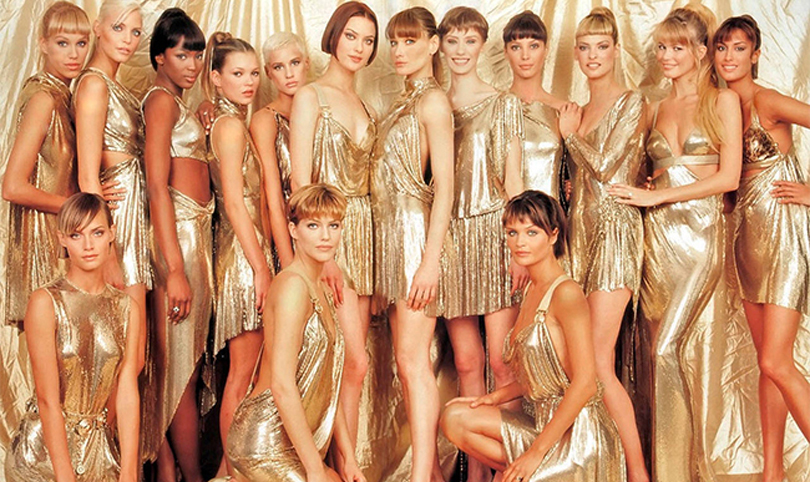
Of course, Gianni wasn’t just flash and celebrity friends. He became an innovator to pursue the bold, shimmery metallic garments of his dreams, and invented the now-popular mesh-like metallic fabric Oroton, a lightweight chainmail textile resembling a reflective fluid metal that Gianni premiered in 1982 at a fashion show at the Paris Opera.
Also in 1982, he expanded the Gianni Versace line to include jewellery and housewares – one of the first fashion brands to do so. And as his success continued to grow, Gianni began opening boutiques around the globe.
In 1989, he launched Versus Versace (a diffusion line that he created for Donatella; it was discontinued in 2005 but relaunched by Donatella in 2009) and finally expanded into haute couture with the launch of Atelier Versace in 1989. The following year, he showed his first Atelier Versace couture collection during Haute Couture Week at the Hôtel Ritz in Paris.
On the runway, he grabbed fashion headlines with boundary-pushing collections that featured high art (Versace’s pop art-inspired spring/summer 1991 collection incorporated Andy Warhol’s screen prints of Marilyn Monroe and James Dean into his clothing) and sophisticated bondage gear (Versace’s fall/winter 1992 collection was provocatively titled Miss S&M).
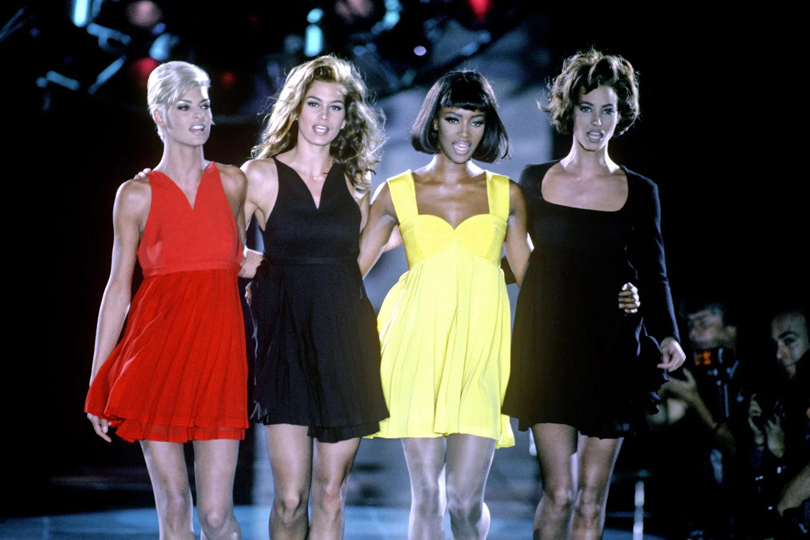
He was instrumental to the dawn of “the supers,” repeatedly enlisting (for top dollar) supermodels to glide along his glittering runways and be the faces of his brand…generating endless press coverage along the way. Most famously, in March 1991, he called on Linda Evangelista, Naomi Campbell, Christy Turlington (often referred to as the holy trinity of supermodels) and Cindy Crawford to walk in his fall/winter 1991 runway show, lip-syncing to George Michael’s hit song “Freedom! ’90.” The strut – which took place shortly after Michael’s famed music video starring the four supermodels (along with supermodel Tatjana Patitz) was released – is still regarded as one of fashion’s most triumphant moments.
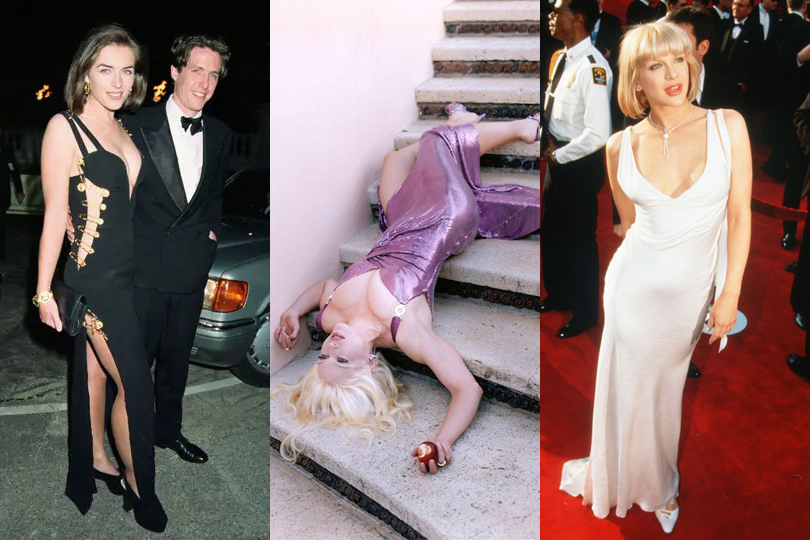
Gianni was a marketing genius, generating endless press coverage for the Versace brand. Just a few examples: Elizabeth Hurley wore his black Versace safety pin dress to the premiere of Four Weddings and a Funeral on May 11, 1994, at Leicester Square in London, England; he convinced Madonna to star in a high-profile spring/summer 1995 ad campaign lensed by Steven Meisel (including one memorable shot of Madonna as Sleeping Beauty lying on a flight of stairs with a bitten apple in hand); and he stunningly remade Courtney Love’s grunge-princess image with the pristine white bias-cut satin column that she wore to the 69th annual Academy Awards on March 24, 1997.
The Medusa mythos
From the beginning, the Versace aesthetic was as recognizable as it was inimitable: Greco-Roman motifs, Baroque swirls, and gilded opulence layered with punkish sex appeal. Maybe that’s why there seemed no rush to have a formal logo for the brand. Gianni did not release a logo for the company until 1980, two years after the brand’s launch, and it featured only the official company name (“Gianni Versace” at the time) in a modern font. In 1997 the fashion house underwent its official name change, dropping the Gianni portion of the name and officially making the name simply “Versace.”
The iconic Medusa head made its first appearance in the early ’90s. Gianni designed the logo in 1992, reportedly after he remembered seeing it in ancient ruins around Reggio Calabria that he and his siblings had played in as children.
Not much about the image has changed since it was introduced. A line-drawn Medusa looks at us dead on with a slight smile, set in a circle surrounded by a meandros (or key border) that’s typical in Greek design. The logo remains one of the most iconic fashion symbols of all time and stands out in a sea of minimalist branding.
According to Greek mythology, Medusa was a monster created by the goddess Athena. Medusa, also called Gorgo, was one of the three monstrous Gorgons, generally described as winged human females with living venomous snakes instead of hair. According to legend, those who gazed into Medusa’s eyes would turn to stone.
It was no accident that Gianni chose to use an image of the head of Medusa, one of the most well-recognized figures from Greek mythology, as the house’s logo. “Medusa made people fall in love with her and they had no way back,” he said. “I hoped my clothes would have the same effect.” They did.
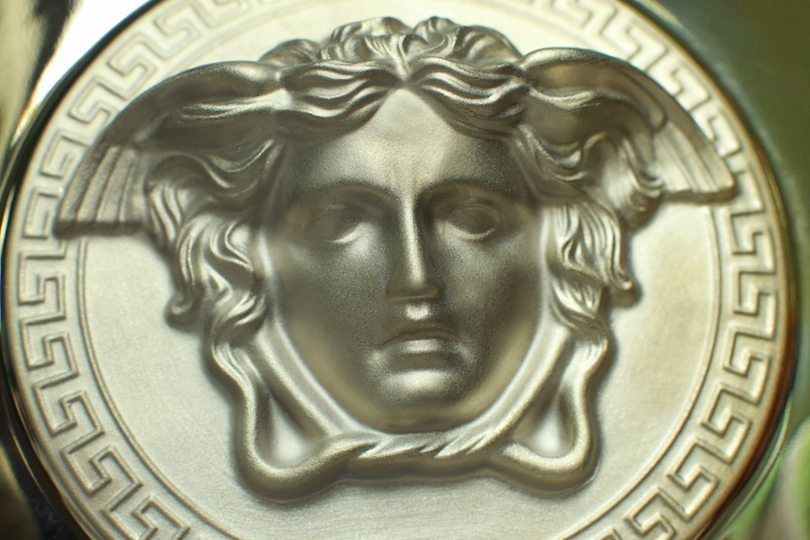
Supposedly, Gianni wanted the Versace logo to emulate the shock and beauty that one feels when seeing Medusa’s head for the first time.
“When people look at Versace, they will have to feel terrified, petrified, just like when you look into the eyes of the Medusa.”
An LGBTQ+ advocate in a conservative era
Gianni’s radicalism wasn’t just aesthetic. As an openly gay man who was thriving in the ’80s (a decade of political conservatism) and the less tolerant cultural climate of the ’90s, he was a quiet but resolute force for visibility.
At a time when homosexuality was still taboo in much of the world, Gianni never cloaked his sexuality. In fact, in July 1995, two years before he was murdered, Gianni did the unthinkable when he spoke to Brendan Lemon of LGBTQ+ magazine The Advocate about his sexuality and his long-time partner, Antonio D’Amico, a model he had met in 1982.
With the inclusion of some subtle details, Lemon’s article created an unheard-of portrait of Gianni and Antonio as a couple: Gianni as the showman, and Antonio as his calmer companion. “D’Amico sits in…and chips in the occasional well-informed comment,” Lemon wrote. “It is D’Amico who knows every detail of the designer’s peripatetic lifestyle.”
Outside of Gianni’s very public coming out, he was a friend to the LGBTQ+ community at a time when it was less than fashionable. During the AIDS crisis, when so many in the fashion and art worlds remained silent, Gianni was outspoken in his support of those affected, personally funding medical research and hospital initiatives. His 1991 and 1992 collections in particular read like sartorial manifestos for liberation and pleasure in defiance of stigma and fear.
The final act
Professionally, Gianni thrived from the beginning of his career. Personally, there were ups and downs, like in 1993, when he was diagnosed with a rare cancer of the inner ear. Gianni battled this cancer successfully, with Antonio by his side, and then began to pass much of his business responsibilities onto his family.
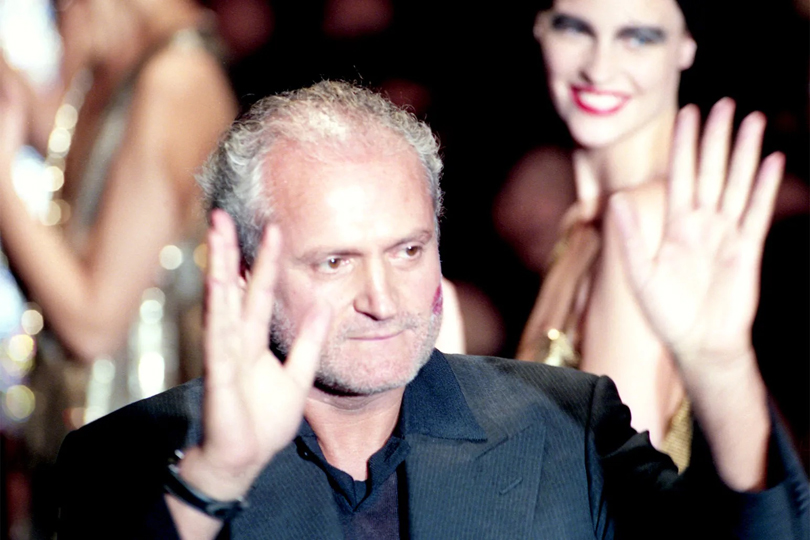
Gianni presented his last fashion show in Paris on July 6, 1997, just nine days before he was murdered. Days after the show, on July 10, Gianni and Antonio returned to Gianni’s palatial 1930s Miami villa, then known as Casa Casuarina, that Gianni had purchased back in 1991. The 10-room, three-storey Mediterranean-style mansion is located at 1116 Ocean Drive, a quieter part of the popular Miami Beach road.
At around 8:30 a.m. on the morning of July 15, 1997, Gianni exited his mansion clad simply in a white T-shirt, black shorts and sandals, and walked down Ocean Drive to retrieve his morning magazines. Usually, his assistant would have done that, but on this occasion Gianni decided to go himself. On this particular morning, he spent about $15 on five different magazines – Business Week, Entertainment Weekly, People, The New Yorker and Vogue – and then headed back home, less than a 10-minute walk away. As he was opening the gates of the palazzo, he encountered a man dressed in a grey T-shirt, black shorts and a white hat, and carrying a backpack. The man, Andrew Cunanan, fired twice, shooting Gianni in the head at point-blank range with a .40 caliber Taurus PT100. He then fled the scene, leaving Gianni lying on the right side of his front steps. Cunanan was followed at a distance by at least one witness and quickly disappeared into a nearby parking garage.
Eyewitness Eddie Bianchi was at an inline skating shop nearby and ran towards the direction of the shots. “We were right there watching and there’s nothing you can do,” he told The New York Times in 1997. “His blood was coming out like crazy. He shook a little bit and stopped moving.”
Inside the gates, Antonio was waiting for him to return when he heard the gun shots. “I felt as if my blood had turned to ice,” he told The Observer, according to The Guardian. He and their butler jumped up. “The house had stained-glass windows so we couldn’t see what had happened from inside, so we had to open the gate.
“I saw Gianni lying on the steps, with blood around him,” he recalled. “At that point, everything went dark. I was pulled away, I didn’t see any more.”
Gianni Versace was pronounced dead at Jackson Memorial Hospital’s Ryder Trauma Center in Miami, just seven miles away from Casa Casuarina, at 9:21 a.m. He was 50 years old at the time of his death.
The news of the murder sent shock waves across the globe, and the media almost immediately descended on South Beach to cover the news of the unbelievable assassination.
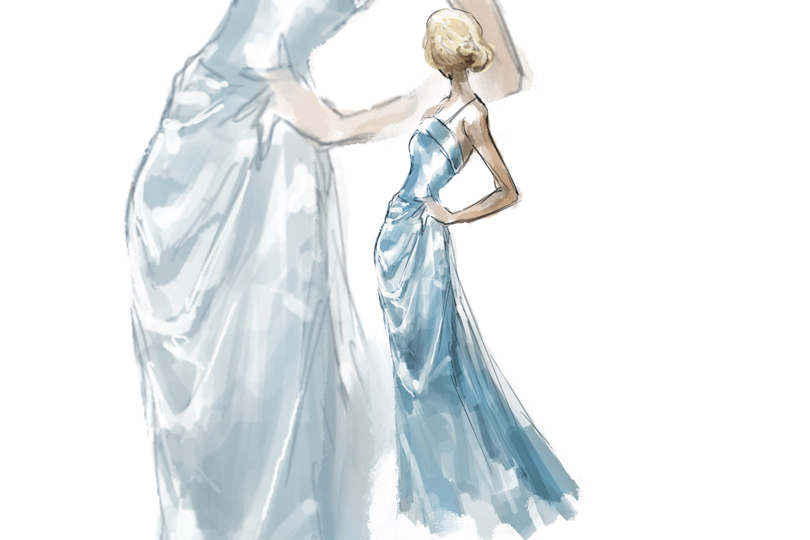
Diana, Princess of Wales, who famously had posed for the cover of Harper’s Bazaar in an ice-blue Atelier Versace gown adorned with golden studs and glass beads (the first gown he created for her), was in the South of France when she found out about Gianni’s untimely passing. Issuing a statement about her dear friend, she said, “I am devastated by the loss of a great and talented man.”
Gianni was the last victim of Cunanan, a serial killer who had earlier murdered four other men. Described as “gay gigolo down on his luck” by Vanity Fair, the 27-year-old Cunanan was a Filipino Italian American who had been raised in San Diego. He was highly intelligent, spoke two languages, and since his teenage years had sought to live a life of riches and comfort.
One of the biggest questions marks left behind was whether Gianni and Cunanan had known one another. Some sources claim that Cunanan met the designer in San Francisco in October 1990, years before the shooting, when Gianni was in town to be recognized for the costumes he had designed for the San Francisco Opera production of Richard Strauss’s opera Capriccio. But the Versace family has been adamant over the years that the two had never met.
One thing is for certain. For reasons that remain unclear, Cunanan was on a rampage in the spring of 1997, committing four murders between April 27 and May 9. The first was his supposed best friend, 28-year-old Jeffrey Trail, a former Naval officer, whom he bludgeoned to death with a hammer in Minneapolis. A few days later, he shot and killed his crush, 33-year-old architect David Madson, and then dumped his body near East Rush Lake in Minnesota. Cunanan then moved on to Chicago, where he murdered 75-year-old real estate businessman Lee Miglin. While some accounts claim Miglin was a client of Cunanan’s, the Miglin family says the patriarch had not met his killer before that night. Less than a week later, Cunanan murdered his fourth victim, 45-year-old cemetery worker William Reese, in New Jersey. He then took Reese’s red Chevrolet 1995 pickup truck and drove south to Miami, where he shot the designer weeks later.
Working with the television show America’s Most Wanted, the FBI made Cunanan the 449th addition to its “Ten Most Wanted Fugitives” list on June 12, 1997.
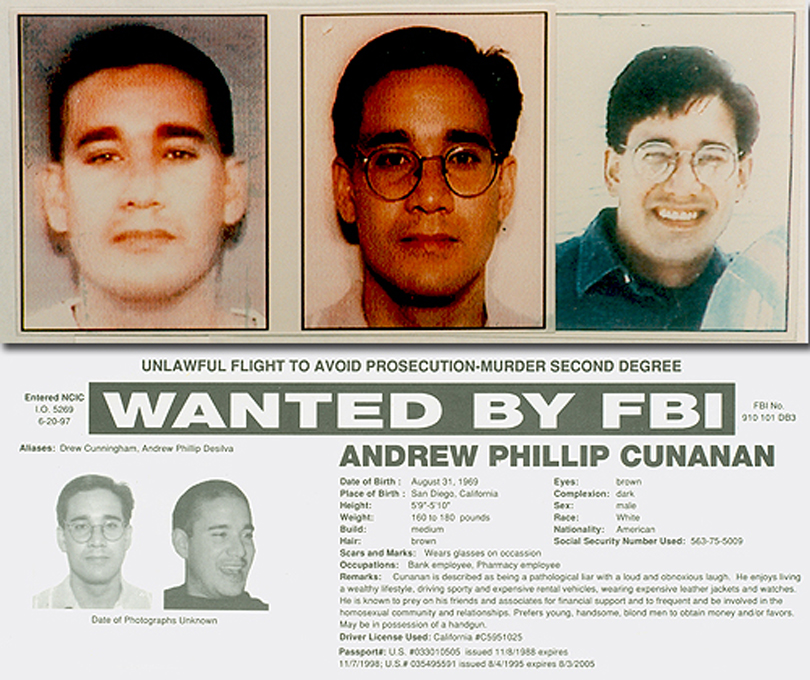
With Gianni’s murder, the FBI began to close in on Cunanan. However, Cunanan died by suicide on a houseboat on July 23, 1997, eight days after murdering Gianni. Without a suicide note, no explanation was ever revealed for why he had killed the beloved fashion designer – or how long he had targeted him.
Gianni’s murder was not just a tragedy: it was a rupture. The fashion world mourned not only the loss of a great designer, but the end of an era. His memorial service, held at Milan’s gothic Roman Catholic Cathedral (Duomo) on July 22, was attended by more than 2,000 people, including a devastated Donatella as well as Carolyn Bessette-Kennedy, Naomi Campbell, Madonna, Elton John and Diana, Princess of Wales (who would be killed in a car accident a little over a month later).
Gianni’s body was cremated; his ashes were returned to the family’s estate near Cernobbio and buried in the family vault at Moltrasio cemetery near Lake Como.
Yet his spirit never left the house he built. To keep his legacy going, the family focused on his fashion empire. In his will, Gianni had left a 30 per cent stake to Santo, a 20 per cent stake to Donatella, and the remaining 50 per cent to Donatella’s daughter, Allegra – though she was only 11 at the time. Donatella stepped into the creative helm and though her vision was distinct, she preserved the heart of her brother’s ethos.
Less than three months after Gianni’s death, Versace showed at Milan fashion week on October 10, 1997. But there was no rivalry with the presentation of the collection: Giorgio Armani, Donna Karan, Miuccia Prada and Karl Lagerfeld were all in the audience offering Donatella their support.
“My brother was the king and my whole world had crashed around me,” she told The Guardian in 2017. “Now, I feel like the death of my brother made me strong. But for a long time it was a trauma…. I had to be strong for the company. But most of all I had to be strong for the family.”
As for Gianni’s beloved Casa Casuarina? It has changed hands throughout the years and is now a boutique hotel with 13 luxurious guest suites and a restaurant called Gianni’s Restaurant (although it has no affiliation to the Versace family). The property is still a place of mourning, with a daily parade of people stopping at the front staircase where Gianni was shot to take pictures or put down flowers.
Legacy of a legend
At the time of his death, Versace’s empire was valued at $807 million and included 130 boutiques across the world.
Today, the Versace name endures as a symbol of bombast and boldness. After Gianni’s death, under the leadership of Donatella and with new backing from global luxury conglomerates, the brand continued to thrive, leaning into its heritage with campaigns that embraced its history and pushed it forward – still provocative, still fearless.
In September 2018, Versace was sold to Michael Kors Limited; in January 2019, the brand became part of the Capri Holdings Limited group, creating a new luxury group together with Michael Kors and Jimmy Choo, and keeping Donatella Versace as head of creative design.
In April 2025, Prada Group announced that it had acquired the Italian fashion house for a tentative 1.25 billion euros. A month prior to the acquisition, Donatella announced that she would be stepping down and into a new role as chief brand ambassador. Though Versace is juggling new leadership – creative and corporate – Prada Group emphasized that the brand would maintain its artistic DNA and authenticity.
But Gianni’s legacy transcends any single gown or campaign or acquisition. His shows were more than collections; they were spectacles. His designs were more than clothing; they were liberation. In a culture now saturated with “quiet luxury,” Versace’s audacity reads almost like rebellion. But that’s the thing about Gianni: he was never afraid to provoke, to seduce, to delight.
Long live the king of decadence.

Want more? You can read other stories from our The Story Of series right here.
Trending
 Here’s Every Song From ‘Love Story: John F. Kennedy Jr. & Carolyn Bessette’ [UPDATED]
  10 Memorable Images Of Supermodel Gia Carangi (1960–1986)
  Alexander McQueen’s 10 Most Iconic Runway Shows
  THE STORY OF: Carolyn Bessette-Kennedy’s Narciso Rodriguez Wedding Gown
  These 3 Diamond Alternatives Are Trending In Engagement Rings