
Part of an ongoing series of 29Secrets stories, taking a deep dive into the history of legendary beauty products and iconic fashion moments…
By Christopher Turner
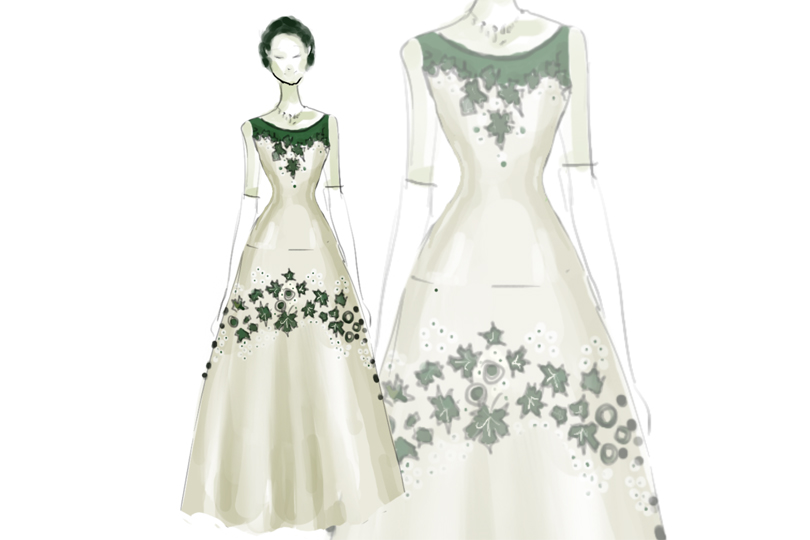
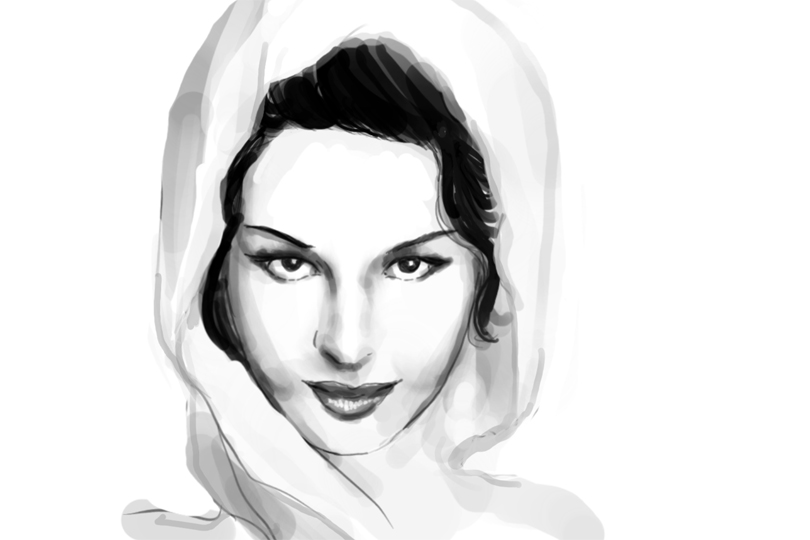
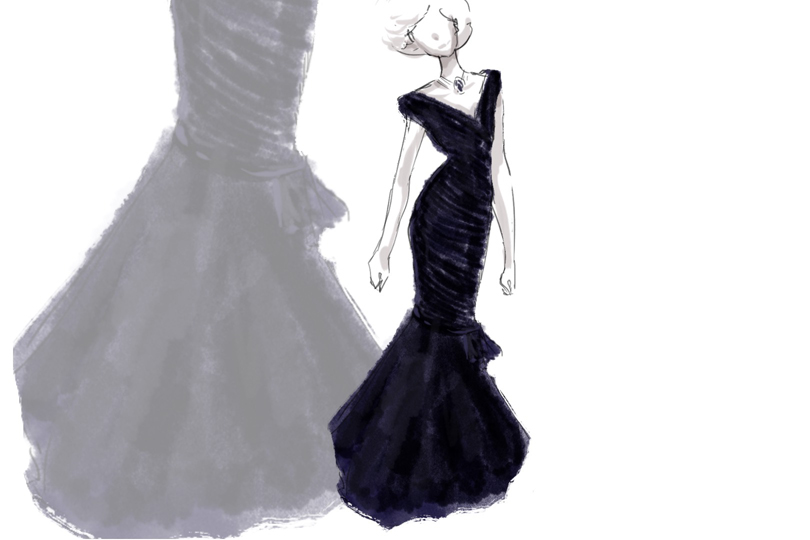
Illustration by Michael Hak
It’s hard to believe, but it has been 40 years since one of Diana, Princess of Wales’ most iconic fashion moments.
In November 1985, during an official visit to Washington, D.C., Diana, Princess of Wales, captured the world’s attention when she attended a state dinner hosted by US President Ronald Reagan and First Lady Nancy Reagan at the White House. For the occasion, Diana chose to wear a midnight-blue (often perceived as black) silk velvet evening gown designed by British couturier Victor Edelstein with an off-the-shoulder neckline, fitted bodice and full skirt. The dramatic gown represented a clear departure from the softer, pastel looks that she had often been photographed wearing since entering the public eye. This dark velvet evening gown reflected a new, more confident phase in Diana’s wardrobe: one that merged royal protocol with the streamlined drama of couture at the time.
That evening, Diana famously danced with actor John Travolta, a moment widely photographed and quickly syndicated to newspapers around the world. Almost overnight, the dress was dubbed the “Travolta dress,” a name that has endured in fashion history ever since. The images of Diana wearing the dramatic dress instantly helped solidify her reputation as a style leader, showing how she used clothing not only to meet formal obligations but also to project a modern, approachable image of monarchy.
Today the “Travolta dress” is recognized as one of the most important garments in Diana’s wardrobe, frequently cited in style exhibitions as a turning point in her sartorial evolution. Its design, repeated wearings, and later high-profile auction sales trace a full arc – from couture commission to international icon and, ultimately, to a museum-held artifact of royal fashion history. Here’s the full story of the so-called “Travolta dress” created by Victor Edelstein and worn by Diana, Princess of Wales.
The making of a modern court gown
London-born Victor Edelstein was a high-profile British couturier during the 1980s, best known for his countless designs worn by Diana. In the early 1980s, as the princess (and her fashion choices) began to dominate the British press, Edelstein began quietly reshaping Diana’s eveningwear with more sophisticated designs that were aristocratic and modern, yet, most importantly, still abided by royal protocol.
Edelstein, who closed his fashion house in 1993 and now works as a painter, has recalled on numerous occasions that Diana spotted a sample design of a wine-red off-the-shoulder evening gown at his studio that had been inspired by Edwardian fashion and had a “slight sweep of costume drama.” Diana loved the dress and asked if it could be made for her in midnight blue – so the gown could register as ink-black under the flash of cameras.
Edelstein obliged and got to work on the gown: an off-the-shoulder dress that featured a lightly boned bodice, ruching through the torso, with a diagonally swathed skirt that hugged the figure to the knee before it dramatically flared to the ground. The dress also featured a side bow that added a whisper of costume drama without tipping into confection.
The fittings for the midnight blue evening gown took place at Diana’s private apartments at Kensington Palace in fall 1985. After the final fitting, it has been said that Diana was so delighted with the gown that she rushed to show it to her husband, Charles, Prince of Wales, who reputedly told her she looked wonderful in the gown and that it would be perfect to wear with one of her signature pieces of jewellery, her sapphire choker necklace which featured seven strands of pearls.
The black velvet waltz
On November 9, 1985, the White House hosted a gala dinner organized by then-US President Ronald Reagan and First Lady Nancy Reagan. Diana and Charles were among the distinguished guests that night, which mixed Washington power players with a little Hollywood star power. The evening was largely centred around the royals’ arrival and transatlantic salutations, until the focus shifted to an unforgettable moment. Just after midnight, actor John Travolta, who had become a global superstar and America’s leading dancing heartthrob thanks to his starring roles in Saturday Night Fever (1977) and Grease (1978), approached the princess as the band began playing the groovy soundtrack of his iconic disco film.
The timeline is uncontested; what has been debated for decades is how orchestrated the dance in the Entrance Hall actually was. Travolta, who was wearing a sleek black suit that night, later suggested Nancy Reagan helped arrange the moment; others recall it as a wish Diana had voiced privately. Either way, Diana captivated guests as she gracefully twirled across the floor wearing her midnight-hued, velvet frock as photographers captured a sequence that refashioned her royal image in real time.
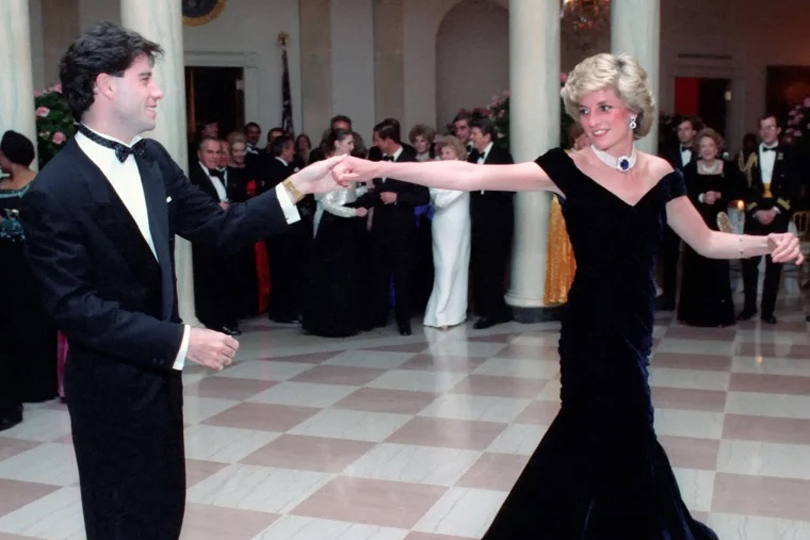
The photographs and TV footage of the pair gliding around the White House Entrance Hall were widely circulated around the globe the next morning, along with headlines that referred to the Edelstein gown as the “Travolta dress.”
How many times did Diana wear the “Travolta dress”?
Fashion’s relationship with repetition is complicated. For royalty, repeating a dress can potentially signal frugality and normalcy, but Diana sidestepped any preconceptions by wearing the Edelstein midnight blue evening gown multiple times across the late ’80s and early ’90s – eight times, by one curator’s count – each outing reinforcing the gown’s status as a signature.
Beyond the White House, Diana wore Edelstein’s creation the following year to the 1988 London premiere of Oliver Stone’s film Wall Street (where she famously met actor Michael Douglas), to a West German banquet in the late ’80s, and for formal portraits, including her last official royal portrait photograph, taken by the Earl of Snowdon, in 1997.
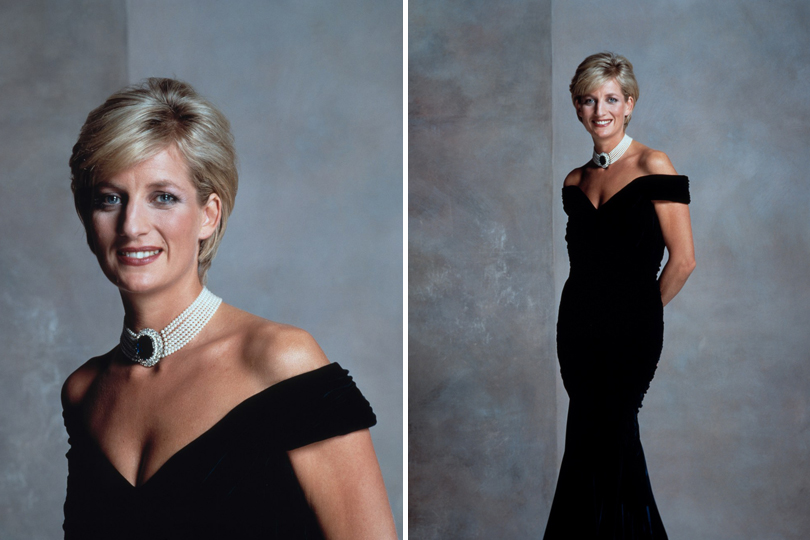
The Independent called the Edelstein gown one of Diana’s favourites from a closet of showpieces, while later auction notes called out the gown’s precise cut and interior engineering, details that help explain why it still photographs like sculpture.
John Travolta’s reflections on the dance
Thinking back on that night some three decades later, Travolta has had a lot to say. He’s spoken about the interaction countless times, adding to the mythology that surrounds the dress and the dance.
In a 2007 interview with Dutch TV station Één, Travolta said that he’d “never forget it,” according to a report in People.
“I didn’t know or expect to dance with Lady Diana, and it was the president’s wife, Nancy Reagan, that said, ‘It is her wish,’” the actor recalled. “At midnight, I had to tap her on her shoulder, and I had to say, ‘Would you care to dance?’ She turned around and dipped her head in that Lady Diana way, and we were off for 15 minutes dancing.
“I’ll never forget it,” Travolta continued. “I’m so honoured that I was able to experience this, and I know for a fact that it was her highlight of being in the United States; it was her favourite moment. So I feel I made her life better, she made my life better, and I’m very sorry that she’s not here.”
In 2019, Travolta told Yahoo Entertainment a similar rendition of his famous interaction with Diana that night.
“I didn’t know until I got there that I was supposed to dance with her,” Travolta revealed. “[Princess Diana] kept that a secret when she met me. She didn’t know that Nancy Reagan hadn’t told me yet that this was the plan – that I was the Prince Charming of the evening.
“I was awestruck by her. She took the lead, and I thought, ‘That’s not happening! I need to tap into my school days of ballroom dance lessons and prove I can lead her…’ I could probably sketch it from memory – it was that distinctive.”
In 2021, Travolta relived the moment again during an interview with Esquire Mexico, admitting that he hadn’t prepared to dance with the Princess of Wales.
“I didn’t think they’d ask me to dance with her. I had the great privilege and honour of doing so, and I thought, ‘There must be a reason for doing this and I better give it my all,’” he revealed. “That meant lead the dance well and make sure we had fun. That was the easy part, but just the fact of greeting Diana appropriately, being confident and asking her to dance was a complicated task.”
Travolta also told the magazine that the experience felt like a “fairy tale” that he would continue to remember for decades to come.
“Think of the setting. We were at the White House. It’s midnight. The stage is like a dream. I approach her, touch her elbow, invite her to dance,” he said. “She spins around and gives me that captivating smile, just a little sad, and accepts my invitation. And there we were, dancing together as if it were a fairy tale.”
He added, “Who could ever imagine something like that would happen to them someday? I was smart enough to stamp it in my memory as a very special, magical moment.”
Giving back to charity
Just months before her death on August 31, 1997, Diana turned her closet into a philanthropic instrument that would benefit a variety of AIDS and cancer charities, sending a collection of her evening and cocktail dresses to Christie’s auction house in New York. The “Travolta dress” was part of the collection that she sent.
Florida-based businesswoman Maureen Rorech Dunkel spent a total of $870,000 US at the Christie’s auction in June 1997, just eight weeks before Diana was killed in a car accident in Paris in 1997 at age 36. Dunkel purchased 12 different gowns, which had all been worn by the princess for state visits and dinners. The “Travolta dress” was the most expensive dress that Dunkel purchased, a record $200,000 US.
What followed reflects the strange economics of royal fashion. After the record-breaking 1997 auction, parts of Diana’s wardrobe entered private collections, toured for charity exhibitions, or returned to the market. When Dunkel filed for bankruptcy in 2011, she was forced to put some of her collection of Diana dresses back up for auction, but the “Travolta dress” was one of six dresses that she opted not to sell. It resurfaced at auction in March 2013 when it was auctioned off by Kerry Taylor in London on March 19, 2013, fetching £240,000 (around $360,000 US). It was reportedly bought by “a British gentleman as a surprise to cheer up his wife.”
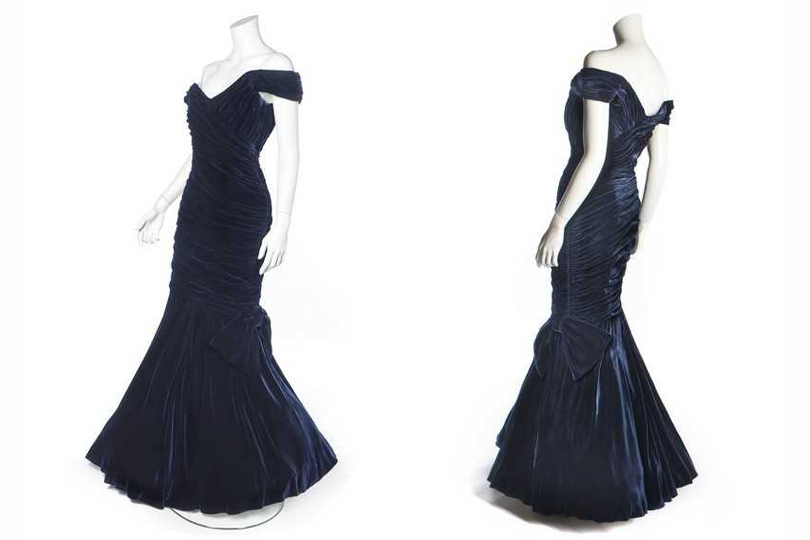
For most of the next decade the dress was largely tucked away, as private treasures often are.
Then, in 2019, the story took its most satisfying turn. The “Travolta dress” went on sale again in December 2019, but it failed to sell at auction. However, it was sold post-auction to Historic Royal Palaces – the independent charity that cares for Kensington Palace and the Royal Ceremonial Dress Collection – for about £220,000, where it joined the Royal Ceremonial Dress Collection. This collection is an archive of more than 10,000 nationally significant pieces spanning five centuries – uniforms, court gowns, wedding ensembles, and the accoutrements that narrate a country’s public life through cloth.
The acquisition by Historic Royal Palaces was the beginning of a new story for the beloved dress. After its purchase, the independent charity undertook conservation before considering display – standard practice for silk velvet, which is vulnerable to light and handling. Finally, in July 2020, Kensington Palace opened its doors with the “Travolta dress” positioned in the Stone Hall, its dark glow set against portraits of the palace’s former residents.
“By my count, [it] makes it the dress she wore most,” Eleri Lynn, curator of the Royal Ceremonial Dress collection, told People in 2020 when the dress was first displayed. “It was clearly a favourite of hers.
“It stands the test of time and doesn’t date like some of her other early ’80s looks,” Lynn added. “The dress marks a turning point in her fashion story, where the incredible New Romantic frills and ruffles gave way to a timeless, classic silhouette. And the number of times she wore it is a testament to that. You could wear it today and still be the best-dressed person.”
The dress and the dance as a cultural pivot
Much is made, rightly, of Diana’s “Travolta dress.” Fashion historians often treat the Edelstein gown as a hinge. Before 1985, Diana’s eveningwear still carried traces of ingénue romance – ruffles, pastel chiffons, sweet bows – while after the White House, her style arc bent toward sleek, modern minimalism. Edelstein’s creation, with its clean lines, sculpted bodice and deep velvet finish, changed the game and demonstrated how a princess could still look ceremonial while embracing a more contemporary direction. That’s why the “Travolta dress” is famed and studied not only for its White House appearance but also for what it reveals about shifts in royal presentation, media dynamics, and the increasing role of fashion as a form of soft diplomacy.
As for the dance…much has been written about the 15-minute dance and how the photographs made Travolta look like a co-star next to Diana wearing Edelstein’s sculptural dress. But the historian’s answer is simple: it updated how the world saw the monarchy for the TV age. After all, royalty had never really looked this modern or human.
Today, the “Travolta dress” stands as one of the most thoroughly documented and frequently exhibited pieces from Princess Diana’s wardrobe. Now housed within the Royal Ceremonial Dress Collection at Kensington Palace, the gown is displayed periodically as conservation requirements allow. Its trajectory – from couture commission to repeated public wearings, to its inclusion in the landmark 1997 charity auction, and finally to its acquisition by Historic Royal Palaces – illustrates how a single garment can move through several distinct phases of cultural value. More than simply a functional royal evening gown, it is a symbol of Diana’s evolving public image and how she modernized the visual language of the monarchy through her strategic and stylistically influential wardrobe choices.
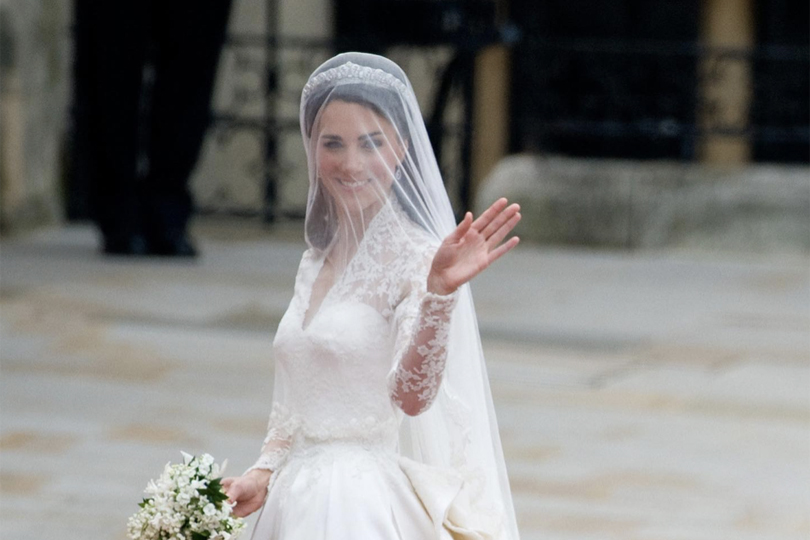
Want more? You can read other stories from our The Story Of series right here, including stories on Diana’s wedding dress and her iconic “Revenge Dress.”
Trending
 10 Memorable Images Of Supermodel Gia Carangi (1960–1986)
  Who Is Madonna Singing About On “Danceteria”? Every Reference Explained
  20 Celebrities Who Posed For Abercrombie & Fitch Before They Were Famous
  20 Actors You Probably Forgot Appeared On ‘Gilmore Girls’
  Fragrance Of The Month: The 7 Virtues Blackberry Lily