
By Christopher Turner
There are few symbols more unmistakably Canadian than the maple leaf. It’s on our flag, our money, our passports, our sports jerseys, our military insignia and just about every piece of Canadiana imaginable. But eight years before the familiar red-and-white Maple Leaf flag was first raised on Parliament Hill, Queen Elizabeth II walked into a state banquet in Ottawa wearing the symbol from bodice to hem.
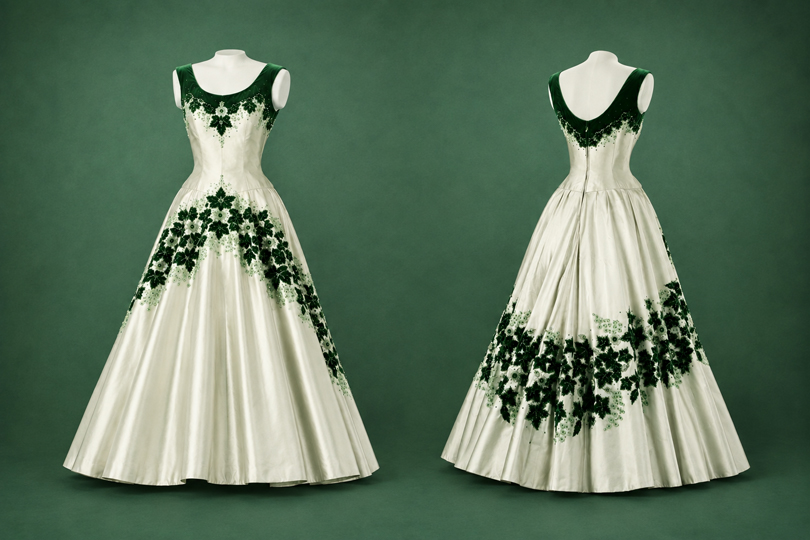
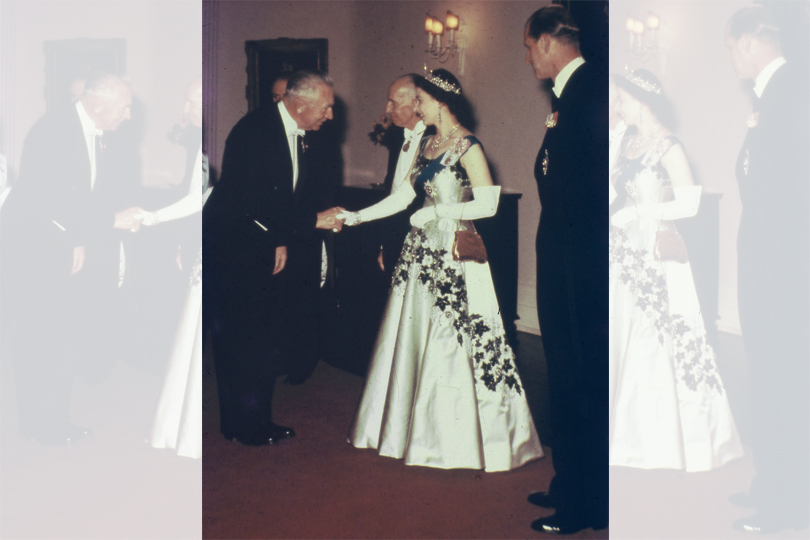
On October 14, 1957, during her first official visit to Canada as reigning monarch, the 31-year-old Queen arrived at Rideau Hall wearing a sweeping ivory-white satin evening gown embroidered with shimmering green maple leaves.
It was spectacular. It was symbolic. And it might just be the most patriotic dress in Canadian fashion history.
Now known as the “Maple Leaf of Canada” gown, the Norman Hartnell creation transformed one of the country’s most enduring symbols into haute couture at a pivotal moment in Canadian history. The maple leaf was already deeply embedded in the country’s identity, but Canada’s current flag—and the singular red maple leaf that would eventually become recognized around the world—was still years away.
Of course, the gown was also an early masterclass in what would eventually become known as diplomatic dressing. Long before red carpet commentators started decoding celebrity outfits for hidden messages, Queen Elizabeth II understood the power of using clothing to acknowledge the country she was visiting. Throughout her 70-year reign, brooches, colours, fabrics and motifs would become part of that carefully considered visual language.
But few would prove quite as memorable—or quite as Canadian—as the gown she wore that night in Ottawa.
Nearly seven decades later, the Maple Leaf of Canada gown remains one of the defining examples of royal state dressing, an extraordinary piece of Canadian fashion history and perhaps the ultimate example of wearing your patriotism on your sleeve.
Here’s the history behind it.
Canada and the new Queen
Queen Elizabeth II reigned from 1952 until her death on September 8, 2022, at the age of 96. She was the longest-reigning monarch in British and Commonwealth history, and was also the first monarch to be proclaimed separately as Queen of Canada.
Before she became queen, Elizabeth visited Canada for the first time in the fall of 1951, accompanied by her husband Philip, whom she had married on November 20, 1947. The royal couple were in Canada representing Elizabeth’s father, King George VI, who had undergone surgery for lung cancer and was unable to travel. There was tremendous popular interest in Elizabeth and Philip’s visit from across the country, and the royal couple threw themselves into Canadian pastimes: attending a hockey game at Maple Leaf Gardens in Toronto, a demonstration of the Calgary Stampede, and square dancing at Rideau Hall.
George VI died the following year, on February 6, 1952, while Elizabeth and Philip were representing him on another royal tour, this time to Kenya. The 25-year-old Princess automatically succeeded to the throne as Queen Elizabeth II. The new Queen and her husband immediately returned to the United Kingdom and ascended to the throne in a climate of tremendous public goodwill.
Elizabeth II was crowned Queen at Westminster Abbey on June 2, 1953—making her the head of state of the United Kingdom, Canada, and other Commonwealth realms.
At her coronation—the first to be televised—she wore a dress that included symbols representing the countries of which she was Queen, including an embroidered maple leaf representing Canada.
It was the first time she would famously embrace the maple leaf—but it certainly wouldn’t be the last.
The Maple Leaf of Canada gown
In October 1957, Queen Elizabeth returned to Canada, in time to become the first monarch in Canadian history to deliver the throne speech and to open Parliament. John Diefenbaker was the Conservative prime minister at the time, and the country was enthralled with the 31-year-old Queen when she arrived in Ottawa.
During her visit, the Queen debuted the now-famous Maple Leaf of Canada gown at a grand state banquet and reception held at Rideau Hall in Ottawa on October 14, 1957. Her gown was designed by Norman Hartnell, the British couturier responsible for shaping much of the Queen’s visual identity during the early decades of her reign.
Hartnell was already legendary by that point. He had designed the Queen’s 1947 wedding gown and later her 1953 coronation dress, the one famously embroidered with floral emblems representing countries across the Commonwealth. So it’s clear he understood something fundamental about royal dressing: symbolism mattered.
For the Canadian tour, Hartnell created an ivory-white satin gown embroidered with a garland of white roses (the emblem of the House of York) and shimmering green maple leaves (the symbol of Canada) cascading across the skirt and bodice. Rather than rendering the symbol literally, he transformed it into couture—allowing the dress to feel recognizably Canadian while maintaining the grandeur expected of a royal state occasion.
“Each leaf is made of green velvet appliquéd with crystal and imitation emeralds,” the Canadian Museum of History in Gatineau, Quebec, wrote on Facebook in 2020. “The white roses are formed with crystals, imitation white pearls, and imitation diamonds.”
The result was subtle enough to feel timeless but deliberate enough that nobody missed the message.
At the time Queen Elizabeth wore the gown, however, perhaps the most recognizable Canadian symbol of all didn’t yet exist: the country’s current flag. The now-iconic red-and-white Maple Leaf flag would not be adopted until 1965—eight years later.
The maple leaf itself, of course, was already deeply woven into Canadian identity. It had appeared on military insignia, coins, coats of arms and other national imagery for generations. But Hartnell’s gown arrived at an interesting moment in that evolution: years before a single red maple leaf would become the instantly recognizable international shorthand for Canada that it is today, the Queen was already wearing the symbol from bodice to hem.
In fact, the gown has earned its own place in the official history of the maple leaf. Canadian Heritage includes the Queen wearing the “Maple Leaf of Canada dress” at Rideau Hall in 1957 as a milestone in its timeline tracing the evolution of the maple leaf as a national symbol. The dress appears alongside moments including the maple leaf’s use on early Canadian coins and military insignia, its inclusion on Canada’s coat of arms, the Great Flag Debate of 1964 and, ultimately, the adoption of the Maple Leaf flag in 1965.
In other words, the gown wasn’t simply decorated with a Canadian symbol. It became a small part of the history of that symbol itself.
“Second only to her dazzling coronation gown of this afternoon was the Queen’s Maple Leaf of Canada Dress,” the Globe and Mail reported at the time. “Each leaf in green velvet was appliqued with crystals and emeralds.… The magnificent gown was so striking and so magnificently worn by Her Majesty that one hoped for a stimulus to Canadian design, with so regal an example.”
“The Queen’s every glance, gesture and smile was reported by the press,” author John Melady wrote in the 2006 book Pearson’s Prize: Canada and the Suez Crisis. “Her ‘Maple Leaf of Canada’ dress got as much coverage as a flood in Valencia, Spain, that left a quarter of a million people homeless.”
A Canadian fashion icon
In many ways, the Maple Leaf of Canada gown established the template for the Queen. Throughout her 70-year reign, she developed a reputation for wardrobe choices that acknowledged the places she visited without turning into costume. There were brooches tied to local history, colours selected for symbolic meaning, and dresses that subtly nodded to host nations.
But the Maple Leaf of Canada gown remains one of the earliest—and arguably one of the most successful—examples.
Over time, it became one of the most celebrated garments in the royal wardrobe, and it remains closely associated with the Queen’s relationship with Canada throughout her decades-long reign. It captured a country in transition and a monarch beginning to define her role for a changing Commonwealth.
The Maple Leaf of Canada gown was worn only once by Queen Elizabeth II. After the state banquet and reception in Ottawa, the dress was donated to the country. Today, the historic garment is preserved as part of the permanent collection of the Canadian Museum of History in Gatineau, Quebec.
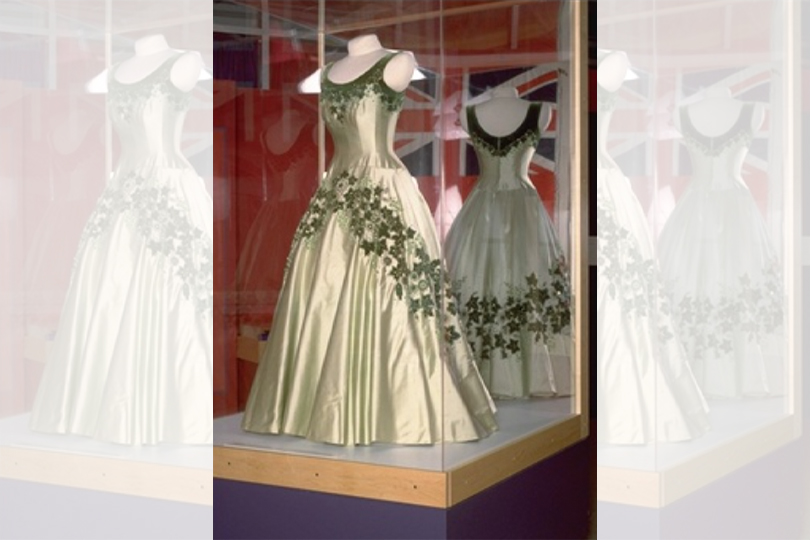
Nearly 70 years after the Queen walked into Rideau Hall wearing it, the gown remains remarkably potent. The maple leaf that Hartnell scattered across its bodice and skirt would soon become even more closely tied to Canadian identity when the country’s new flag was adopted in 1965. What had been a centuries-old national emblem was about to become one of the most instantly recognizable symbols in the world.
There’s also a fitting bit of symmetry to the story. Eight years after wearing the maple leaf from bodice to hem in Ottawa, Queen Elizabeth II formally proclaimed Canada’s new national flag in 1965, helping usher the very symbol embroidered across her gown into a new era.
Which makes the dress feel almost strangely ahead of its time.
There have certainly been other great pieces of Canadian fashion since: Olympic uniforms, Team Canada jerseys, Hudson’s Bay stripes, Roots sweats, Canadian tuxedos and countless red-and-white creations designed to broadcast national pride. But few can compete with the image of a Queen of Canada arriving at Rideau Hall in a couture gown covered in glittering maple leaves—eight years before the Maple Leaf flag itself existed.
So, is it the most patriotic dress in Canadian fashion history?
It certainly has a strong case.
Trending
 10 Memorable Images Of Supermodel Gia Carangi (1960–1986)
  Tanya Taylor Comes Home With Her First Canadian Store In Toronto
  20 Celebrities Who Posed For Abercrombie & Fitch Before They Were Famous
  20 Actors You Probably Forgot Appeared On ‘Gilmore Girls’
  Who Is Madonna Singing About On “Danceteria”? Every Reference Explained