
Part of an ongoing series of 29Secrets stories, taking a deep dive into the history of legendary beauty products and iconic fashion moments…
By Christopher Turner
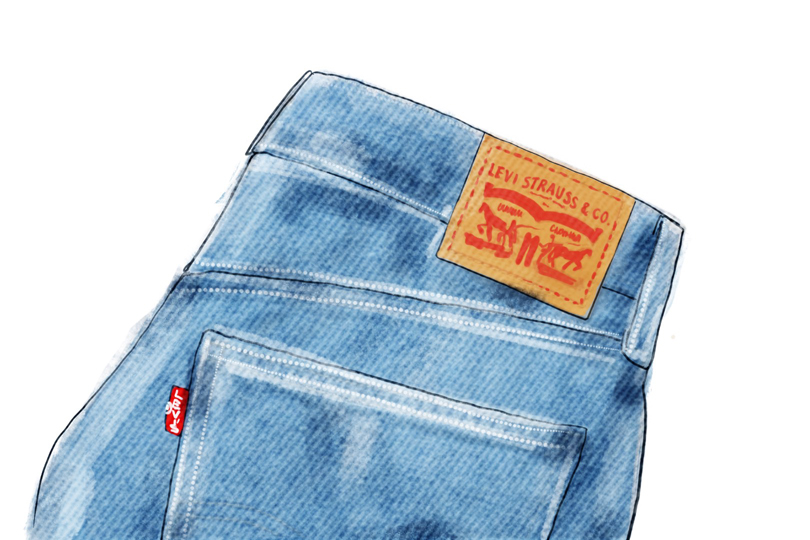
Illustration by Michael Hak
Levi’s is without a doubt one of the most important brands around the world, having been at the forefront of the denim industry for more than 150 years. It’s a foundational American brand with significant cultural impact, pioneering durable denim workwear and then turning that into something much bigger, ultimately claiming near-universal cultural resonance.
Levi’s jeans are worn by miners and movie stars, punks and presidents, supermodels on runways and teenagers at thrift stores. Today, Levi’s offers their jeans in a crazy number of variations, but the Levi’s 501—arguably the most famous garment on the planet—has outlived empires, mirrored seismic social shifts, and rewritten the relationship between clothing and identity. They are one of the few clothing items in your closet that can be considered both an icon and a commodity.
Contrary to popular belief, German-Jewish immigrant Levi Strauss did not arrive in California during the Gold Rush with a bolt of canvas ready to make durable pants for miners. Strauss was in actuality a dry goods merchant in San Francisco who sold various supplies, including denim fabric, who enthusiastically accepted a business proposal. The innovation came from a Latvian immigrant and tailor named Jacob Davis, who proposed using copper rivets to reinforce stress points on work pants to prevent tearing.
Here’s the history behind the 1873 collaboration that led to the birth of the modern blue jean, and how an unlikely brand became a symbol of American style and resilience. Saddle up, because this story is better than your favourite spaghetti western.
Pioneering history
Levi Strauss, the man, was born in Buttenheim, Bavaria (Germany’s largest state by area) on February 26, 1829, to Hirsch Strauss and his second wife, Rebecca Haas Strauss. The young Strauss and his three older brothers and three older sisters were raised in Buttenheim until 1846, when the family immigrated to New York after his father succumbed to tuberculosis. In New York, two of the eldest Strauss brothers already owned a wholesale dry goods business, called J. Strauss Brother & Co., and soon after arriving in New York, Strauss began to learn the trade himself.
Strauss became an American citizen in January 1853, just as news of the California Gold Rush made its way east. Determined to make his fortune, in early March 1854 he went to San Francisco, the commercial hub of the California gold rush, and established a wholesale dry goods business under his own name. (The gold rush peaked between 1849 and 1852, with enormous amounts of gold extracted.) The new business, Levi Strauss & Co., served as the West Coast representative of the family’s New York business.
Strauss was modestly selling dry goods to miners—including canvas, fabrics, clothing, bedding, tools, combs, purses and handkerchiefs—when he received a letter around 1872 from one of his customers, Jacob W. Davis, a tailor living in Reno, Nevada. Davis, who frequently purchased bolts of denim cloths from Strauss, had an idea.
In his letter, Davis disclosed the unique way he made pants for customers who had continually complained about their trousers splitting at the seams. Davis explained that he used copper rivets at points of strain—at the corners of the pockets and the base of the button fly—to make them stronger and last longer. Davis wanted to patent this new idea, but he didn’t have the money for the necessary paperwork and wanted a business partner to get the idea off the ground. Strauss enthusiastically accepted Davis’s offer, and a patent (U.S. patent number 139,121) was granted to Jacob Davis and Levi Strauss & Company on May 20, 1873—a date now considered the official birth of the blue jean.
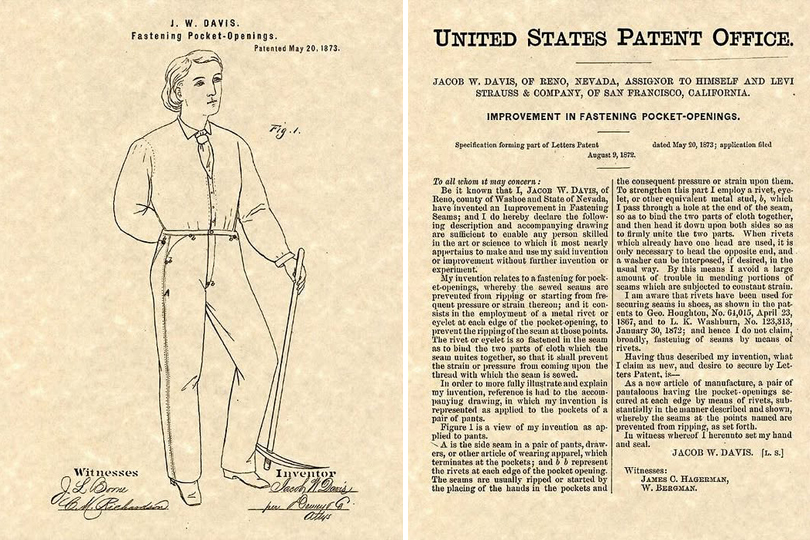
With the pockets in canvas trousers now secure, the jean was born—or, as they were known then, the XX (extra, extra strong).
You may come across some claims that the first pair of Levi’s jeans were made of hemp, but this isn’t true. Davis and Strauss’s earliest iterations of durable trousers were made of heavy canvas, until Davis turned to denim—a more durable, twill-woven cotton dyed with indigo that would go on to colour the fashion world for generations.
Rivets, Arcuate, patches, and that little red tab
Contrary to an early Levi’s advertising campaign suggesting that Strauss sold his first pair of Levi’s jeans to gold miners during the California gold rush, the manufacturing of Levi’s denim “waist overalls” with copper rivets actually didn’t begin until the 1870s, after the patent was secured. (At this point in history, jeans were called “waist overalls”; the term “jeans” didn’t become popular until the 1960s.)
Of course, the rivets were just the beginning of the evolution. Over time, distinct visual signatures emerged that remain a part of every pair of Levi’s jeans sold today.
The introduction of the Levi’s Arcuate quickly followed the copper rivets. Davis started sewing this curved double-stitch design onto the back pocket of their jeans to distinguish them from those made by competitors. This unique brand identifier was first used in 1873, and eventually trademarked in 1943. The stitching was originally applied freehand, evolving from a “batwing” shape to its current form, symbolizing both decoration and pocket reinforcement, though its exact origin (possibly representing wheatgrass or an eagle’s wingspan) remains a mystery due to lost records. More on that later…
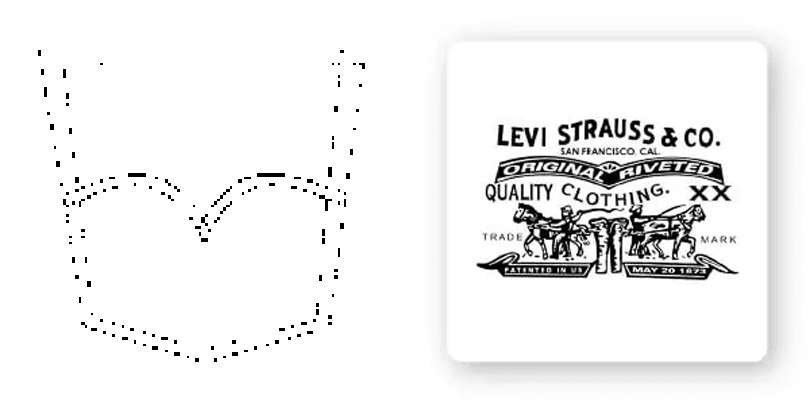
The leather Two-Horse patch that is on the back of the waistband of every pair of jeans was introduced a few years later in 1886, when the patent for the copper rivets was set to expire. The Two-Horse patch was introduced to visually symbolize the incredible durability and strength of the brand’s riveted denim pants…a strength so great that even a pair of horses couldn’t pull the jeans apart. When it was introduced, the Two-Horse patch was a key selling point, helping illiterate customers recognize the quality of the “Two Horse Brand” and its durability compared to competitors’ products. Originally leather, today the patch is often faux leather or fabric, but it still signifies the brand’s legacy of long-lasting, quality workwear.
Levi’s final distinct visual signature, the Red Tab, was added into production in 1936 as yet another way to help distinguish authentic Levi’s from competitors in the marketplace. Interestingly, when it was first introduced on waist overalls and jackets, the red tab spelled “LEVI’S” in all capital letters. It stayed this way until 1971, when the marking changed to “LeVI’S,” with the lowercase “e” becoming the standard for decades. Although the brand has recently reintroduced the all-caps Red Tab (and occasionally orange tabs) on certain premium lines, the tag with lowercase “e” is the most common on modern jeans.
The Levi’s 501
Levi’s earliest miners’ pants may have resembled something between work overalls and trousers, but by the late 1800s, the foundational details of what would become the classic Levi’s 501 silhouette had begun to take shape. Alongside the Arcuate, the Two-Horse patch (and within a few years the Red Tab), the silhouette was gradually evolving from rudimentary miners’ trousers to the five-pocket jean we recognize today.
The name came first. In 1890, the rivet patent went into the public domain; the same year, the company assigned lot numbers to its products, and “501” was used to designate the then-famous copper-riveted waist overalls. Different theories have been suggested throughout the years as to why that number was chosen, but the specific reason is lost to history, as all company records were destroyed in the 1906 San Francisco earthquake and fire. So, there is no actual official information as to why the number 501 was ultimately chosen.
However, what is known is that the XX waist overalls were given the lot number 501 in 1890, and that item was slowly refined over the decades to become the five-pocketed Levi’s 501 jeans that are the brand’s beating heart today. A pair of jeans, structured but not rigid, so timeless that each generation rediscovers its appeal.
Back to Strauss and Davis
1890 is also the year that Strauss and the four nephews—Jacob, Sigmund, Louis and Abraham—who were working with him officially incorporated the company. Levi’s wasn’t Strauss’s only focus; he also carried on other business pursuits during his career and was a renowned philanthropist, but he was still involved in the day-to-day workings of the company at the end of the 19th century.
During the week of September 22, 1902, Strauss began to complain of ill health; he died of natural causes in San Francisco on September 26, 1902, at the age of 73. His death was headline news, and on Monday, September 29, 1902, the day of his funeral, local businesses temporarily closed so their proprietors could attend the service.
Strauss never married, and he left his successful business to his four nephews, who continued to build the brand after his death. Today, Levi Strauss & Co. is a publicly traded company, but the founding family remains the controlling shareholders. Strauss’s nephew Sigmund Stern’s only child, Elise Fanny Stern, married Walter A. Haas, whose descendants (including Miriam Haas, Robert Haas and Peter Haas) still hold the controlling majority of Levi Strauss & Co. today.
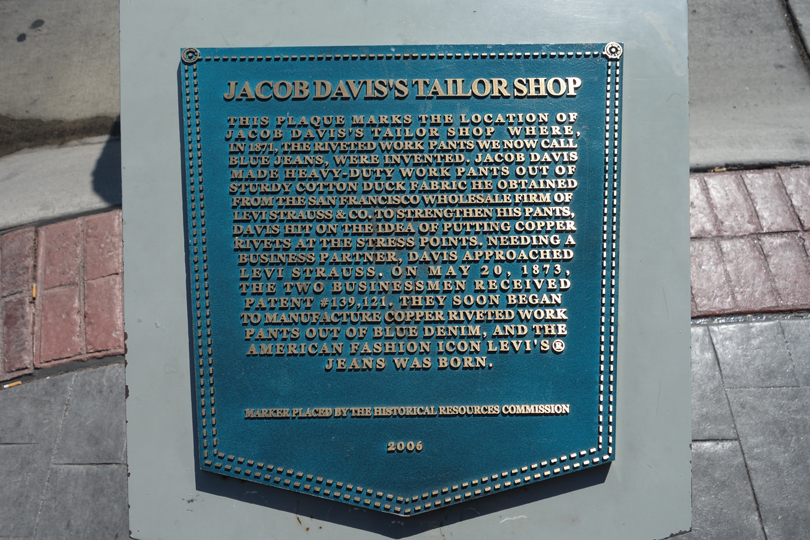
Davis was also part of the brand until his death. As demand for waist overalls grew, his tailor shop was superseded by a manufacturing plant that he managed for Strauss for the remainder of his life. He died in San Francisco almost six years after Strauss on January 20, 1908, at the age of 76. In 2006, a plaque was erected in Reno, Nevada, outside the premises where Davis’s tailor shop was located, to commemorate the fact that jeans were invented there.
Western folklore: How cowboys sold the Levi’s dream
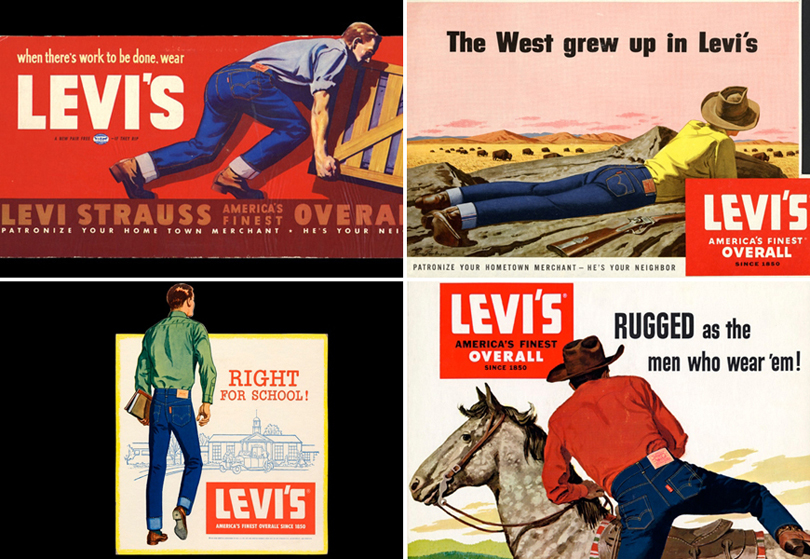
As the 20th century unfolded, Levi’s became inseparable from the mythology of the American West. Cowboys, ranch hands and rodeo riders embraced the jeans for their durability, turning them into symbols of grit, masculinity and frontier independence. When Hollywood began churning out westerns, it propelled that image onto the global stage. John Wayne swaggered across screens in his Levi’s, while Gary Cooper and later Steve McQueen became style icons and helped popularize the rugged look of Levi’s 501 jeans, both in movies and off-screen. Through cinema, Levi’s became not just clothing but ruggedly cool folklore.
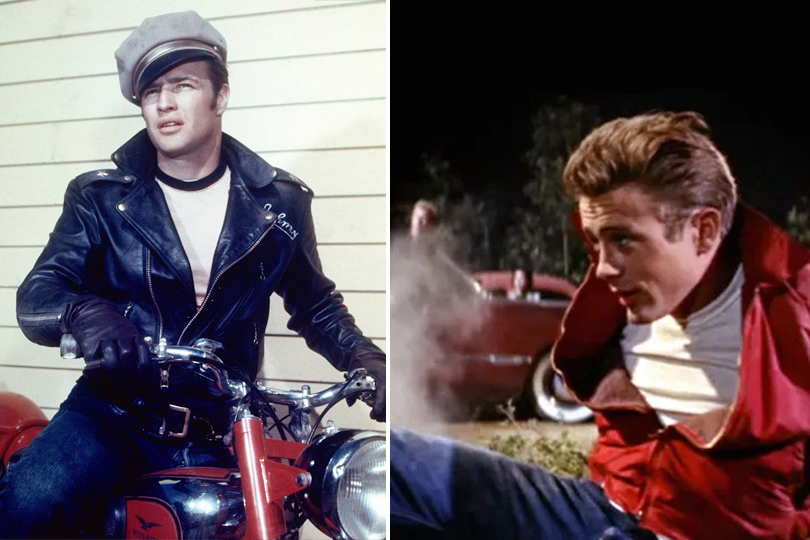
Everything truly changed after the Second World War ended in 1945, when jeans crossed a cultural threshold from utilitarian garment to rebellious youth uniform. Hollywood again played catalyst: Marlon Brando (as Johnny Strabler in the 1953 film The Wild One) and James Dean (as James “Jim” Stark in the 1955 film Rebel Without a Cause)transformed denim into the unofficial dress code of teenage defiance. Their fitted silhouettes and rolled cuffs became expressions of attitude as much as style.
Schools across North America banned jeans in an attempt to curb what they saw as delinquent behaviour—a move that, predictably, only amplified their allure. A garment born out of function was now a symbol of resistance.
By the 1960s and ’70s, jeans had become canvases for personal expression. The counterculture embraced them wholeheartedly—embroidered, painted, patched and frayed. They marched in anti-war protests, swayed at Woodstock, appeared in student sit-ins and feminist meetings, and in general embodied the egalitarian spirit of the era. Levi’s advertising leaned into this imagery, portraying a denim-clad generation united by music, activism and idealism. The brand’s democratic ethos resonated globally, helping turn Levi’s into an international cultural currency.
In many places, particularly behind the Iron Curtain, Levi’s jeans were more than status symbols: they were acts of quiet rebellion. In the Soviet Union, owning a pair of Levi’s communicated access to forbidden Western culture. Levi’s jeans were smuggled across borders, sold on black markets (at extraordinary markups) and worn until threadbare. Simultaneously, early vintage-collector cultures in Europe and Japan began emerging around Levi’s, with Japanese designers in particular studying American denim with almost archival devotion. Their fascination would later kickstart Japan’s world-famous selvedge (or “self-edge”) denim industry, much of it built upon the blueprint Levi’s had inadvertently created.
The 1980s and ’90s marked another transformation. Designer denim was ascendant, and Levi’s found itself in an increasingly crowded marketplace. But reinvention came through marketing: the now-legendary 1985 Laundrette commercial starring Nick Kamen, set to Marvin Gaye’s “I Heard It Through the Grapevine,” restored the 501’s cultural dominance. Sales surged, and the ad reintroduced Levi’s to a new generation as a sensual, stylish essential. Simultaneously, Levi’s threaded itself through hip-hop culture. Artists across the U.S. embraced the jeans as part of their streetwear vocabulary, pairing them with oversized silhouettes, Timberlands and graphic tees. By the 1990s, Tupac, Snoop Dogg, Lauryn Hill and Aaliyah were wearing Levi’s in ways that cemented the brand’s fluency across vastly different cultural spheres.
As the new millennium arrived, another threat emerged as fashion again underwent dramatic shifts. The rise of premium denim brands threatened Levi’s from above, while fast fashion nipped at its heels. Levi’s responded by rediscovering its heritage. The introduction of Levi’s Vintage Clothing (LVC) and Made & Crafted reissued archival fits and fabrics, appealing to collectors and fashion purists. These lines reinstated Levi’s as both authority and innovator, reminding consumers that the brand had written much of denim’s history in the first place. At the same time, Levi’s began addressing environmental concerns that had long plagued denim production, pioneering water-saving techniques and experimenting with cottonized hemp and circular manufacturing.
Levi’s relevance endures
Today, Levi’s jeans occupy a rare position in fashion: both ubiquitous and aspirational. Vintage 501s have become prized possessions in the resale market, sought after for their selvedge edges, unique fade patterns and historical provenance, while new ones are purchased and worn by just about everyone. In fact, there are said to be the equivalent of seven pairs of jeans per person in the world, and Levi’s dominates that number thanks to its enduring status as a global leader in denim.
More than 150 years after Jacob Davis first reached for a copper rivet, Levi’s remains a rare fashion constant: a brand that has adapted without losing its core. The 501 has survived not by chasing trends, but by anchoring itself to a set of principles—durability, utility and democratic design—that continue to resonate across generations. Few garments can move so easily between workwear, rebellion, luxury and everyday life without losing credibility in any of those spaces.
What ultimately sets Levi’s apart is not just its longevity, but its ability to reflect the times while remaining unmistakably itself. From miners and cowboys to movie stars, activists and streetwear pioneers, Levi’s jeans have been shaped by the people who wore them just as much as they have shaped modern style. The details—the rivets, the Arcuate, the Red Tab, the Two-Horse patch—are more than branding; they are markers of a garment that has been continuously rewritten by history.
In an industry defined by speed and disposability, Levi’s enduring relevance feels almost radical. The jeans that began as reinforced work trousers now exist at the intersection of heritage and innovation, worn not because they are new, but because they are proven. In that sense, Levi’s is less a fashion brand than a living archive—one stitched into the cultural fabric of the last century and a half, and still very much in use.
Want more? You can read other stories from our The Story Of series right here.
Trending
 10 Memorable Images Of Supermodel Gia Carangi (1960–1986)
  20 Celebrities Who Posed For Abercrombie & Fitch Before They Were Famous
  THE STORY OF: Madonna’s Iconic Jean Paul Gaultier Cone Bra
  The ELIE SAAB X H&M Collection Includes The Most Romantic Bridal Look
  Product Of The Week: Pilgrim Amaris Recycled Sculptural Barrette