
By: Elio Iannacci
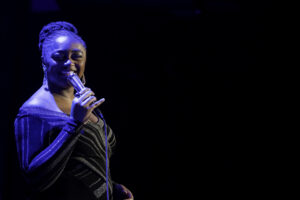
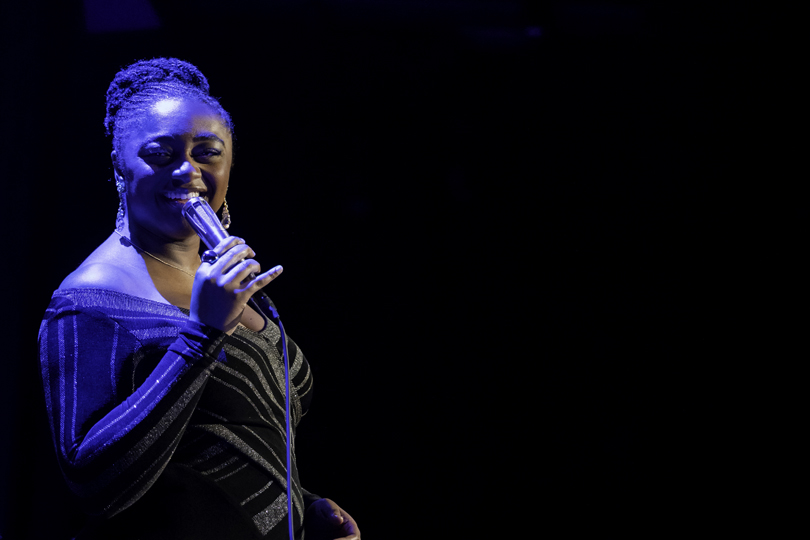
Step into a room where Samara Joy is singing, and the decades seem to fold together. From song to song, you time travel, bouncing between a laid-back Brooklyn speakeasy circa 2026 to Harlem’s Cotton Club in the 1930s. Beyond embodying New York City’s current era, the 26-year-old has a voice that channels the fearless, throaty leaps of Ella Fitzgerald, the visceral force of Nina Simone, and the shapeshifting power of Billie Holiday, slipping from the crisp phrasing of a horn into a velvet contralto in seconds.
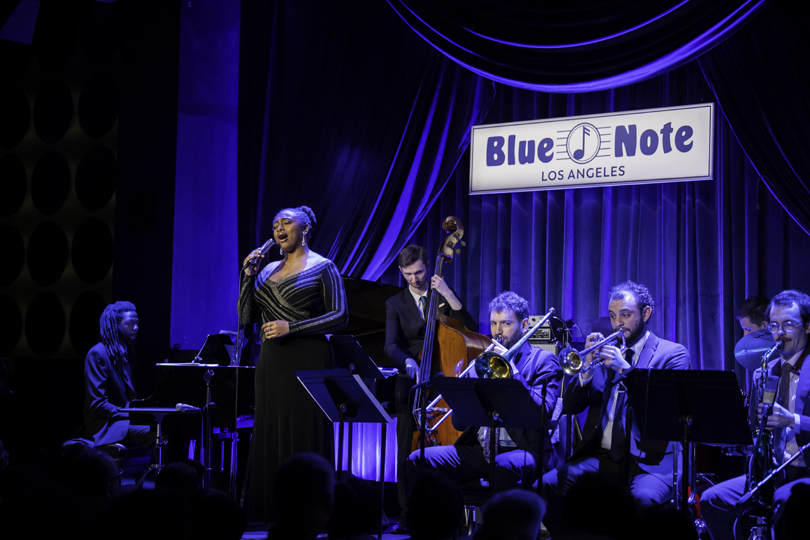
But when the Bronx-born, six-time Grammy winner takes the stage at Toronto’s Roy Thomson Hall on December 2, don’t expect a show that oozes of retro. Coming off her latest disc, Live at the Blue Note L.A., Joy isn’t looking backward, on record or off. Even while singing standards such as “‘Round Midnight,” “No More Blues,” and “Lush Life” (the latter written by the openly gay Billy Strayhorn when he was just 16), she’s staging a stylish revolution in real time. Look closer, and the cues she follows are in how Joy carries herself alongside the greats she studies. Her voice, which spans more than 3.5 octaves, may channel the grandeur of another century, but, like her heroes, her performance of self belongs strictly to the present.
In fact, Joy has never gone inauthentically extra with her wardrobe and her outfit strategy seems allergic to vintage clichés and far too sharp to fall into the trap of Harlem cosplay. Unafraid of dynamic silhouettes, she favors next-gen designers who love to play with structure, from a custom hot-flash-red leather gown by Project Runway alum Laurence Basse at the 2023 Grammys to a sleek black dress by Singaporean-American designer Grace Lee at the 2025 Grammys. Her unbothered ease in them signals a new era for jazz itself. In a chat about her whirlwind year and the road ahead, Joy talks about the icons who taught her to build a universe of her own, the unspoken telepathy that drives her music, hinting at what’s next as the new Creative Chair of the Los Angeles Philharmonic Symphony Orchestra.
Jazz is often seen as music for older audiences, yet so many of its greats, including Billie Holiday, Ella Fitzgerald and Sarah Vaughan, began recording as teenagers. You did too. Why do you think jazz is such a youthful art form?
When it started, it was normal to have dance halls where so many cool kids could go hear a live band and dance. Today, jazz isn’t the pop music of our time yet there are young people who feel a connection to it. Whether through school jazz education programs — which didn’t exist when Ella, Sarah Vaughan, Dizzy Gillespie, and Billy Strayhorn were growing up — or on their own. We’re still drawing from their exploration as a guide for how we can become just as creative and devoted to music as they were. Going to jazz school is a pretty new concept in and of itself, and that’s where a lot of community is based now.
Roughly 40% of Spotify’s jazz streams come from listeners under 30. As an artist in your twenties, what do younger audiences understand about jazz that the industry may be overlooking?
Young people don’t lie about what they like. There’s an audience that loves the mainstream and will listen to artists playing the same song over and over again. Jazz shouldn’t be mainstream. The point of pop is to find one song under three minutes that everybody likes so you get 60 billion streams. Jazz is not supposed to be a return on an investment.
Your song “Peace of Mind” asks listeners where they find theirs: in the places they go, or the people they meet. I’ll turn that question back on you. Where do you find yours?
I’ve only written lyrics/composed that one piece so I’m working to live up to the title of an active composer. As for where I find peace of mind: usually in long walks, in music, sometimes in silence, and sometimes in books. Right now, I’m reading Toni Morrison’s Beloved. I had never read any of her work before—I finished Sula recently, and now I’m on Beloved. She can describe a scene and a feeling with such vivid intensity and detail.
She challenges me to look at simple human emotions because she builds worlds with her words.
Looking back at your previous albums, Linger Awhile and Portrait, how has your own “world-building” changed from your debut until your latest album, Live At The Bluenote?
The biggest noticeable change is my band, the Septet. I was in search of being able to express myself in a collective [through a] collaborative effort drawing from the musical prowess from many. I’ve grown quite a bit since getting the privilege to tour consistently with them. Our day-one gig isn’t the same as four years and multiple months later—we’ve made progress, grown together, had disagreements and talked through them, and changed as a result.
Musicians often describe a kind of “psychic energy” onstage. How would you describe that shared, almost clairvoyant connection with your band?
It comes from shared experience. The difference with a dedicated band is that the chemistry is more developed and lived-in. Playing with someone for four years and truly learning them is very different from playing with a stranger. There are times where I think, “Wow, we really are playing as one.” It doesn’t happen all the time, so what keeps us on our toes and focused is searching to reach those moments.
You’ve won 6 Grammys and drawn standing ovations from Beyoncé, Adele, and Taylor Swift. Is there a song from any of their catalogs you’d love to record or perform as a duet?
When I was nominated for Best New Artist, Spotify asked us all to record a song from a previous Best New Artist winner, so I recorded “Someone Like You”. As for the others, hopefully, I can invite them to a concert in LA—or that they can be part of what I have cooking for the LA Phil.
Is there anything in Beyoncé’s catalog you know well enough to translate into your own style?
I attended her Renaissance tour and loved it but as far as translating those songs to jazz, I’m not sure how they would fit because her tracks are written for a specific full-scale production with visuals and choreography. If you strip them down, a breakdown on an upright bass doesn’t quite have the same effect.
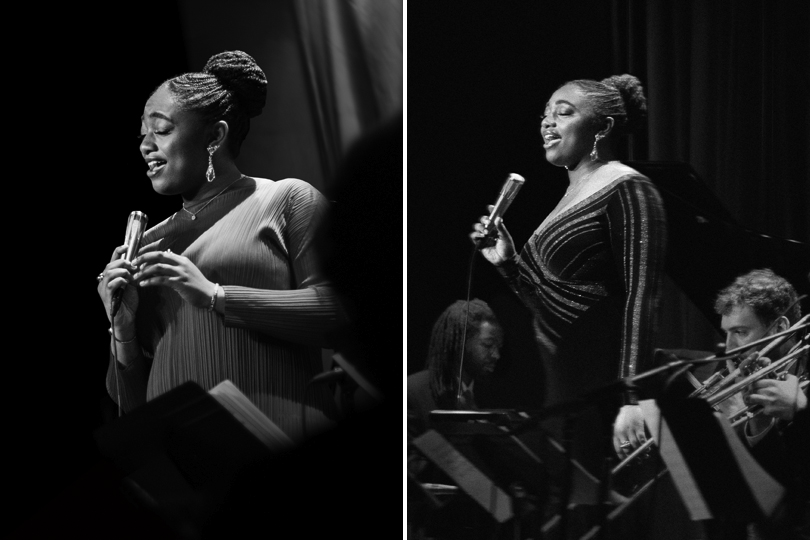
Vogue and Harper’s Bazaar have praised your stage style as groundbreaking. Do you see fashion as an extension of the music?
It can be. If I showed up on stage wearing jeans and a t-shirt, that sends a very different message than an intricate gown. Dressing well makes the performance feel more serious to the audience, and certainly more serious to me.
Which designers have helped you realize that vision?
I wore a dress for the Grammys that I loved by a designer named Jovana Louis Benoit [with Chanel earings and Christian Loubitan heels]. I also wore one of her designs—a pink architectural dress—for my debut New York Philharmonic.
Jazz has a long tradition of glamour, from Billie Holiday and Sarah Vaughan to Nina Simone and Ella Fitzgerald. Whose aesthetic speaks to you most?
I have a picture of a Billie Holiday dress saved in my phone—it’s beautiful. I actually got to see one of Ella’s dresses in person through the Ella Fitzgerald Foundation or the Great American Songbook Foundation. So, I’d say it’s a tie between those two.
Your cover of “Lush Life” on Live At The Blue Note L.A. is remarkable. What are your all-time favorite interpretations of that song?
The one from Billy Strayhorn himself. He has an album called The Peaceful Side where he wrote an instrumental arrangement with a choir, strings, and him playing the melody at the end. There is also a rare recording on YouTube of him singing the song himself. Generally, when I listen to Strayhorn, I go to his own recordings because they are so few and give a glimpse into how he actually played the songs he composed.
Do you believe in New Year’s resolutions, and do you have any goals for the year ahead?
I used to believe in them, but now the year goes by so quickly! It feels like we just did the New Year’s countdown and suddenly it’s November. I just try to do my best every day. Though, if I had to pick one resolution, it would be: no processed sugar.
Trending
 10 Memorable Images Of Supermodel Gia Carangi (1960–1986)
 20 Celebrities Who Posed For Abercrombie & Fitch Before They Were Famous
 ‘Project Runway Canada’ Seamlessly Struts Back With New Season
 Fragrance Of The Month: The 7 Virtues Blackberry Lily
 THE STORY OF: Madonna’s Iconic Jean Paul Gaultier Cone Bra