
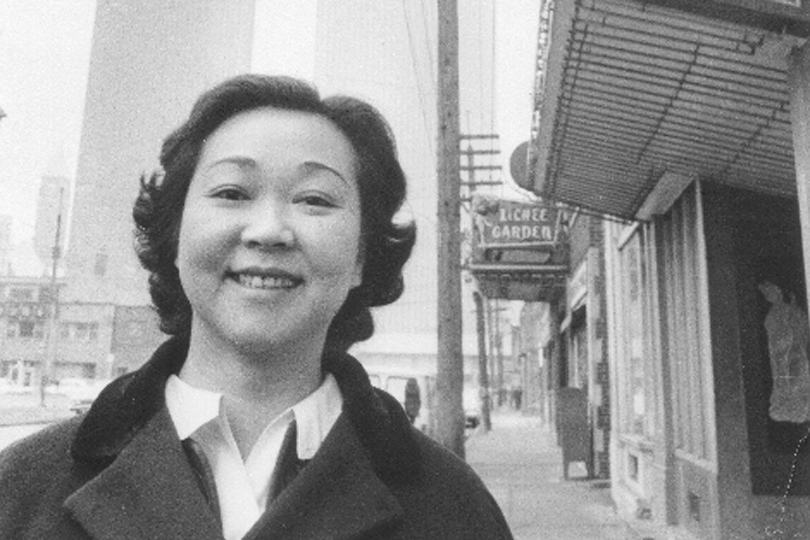
By the late 1960s, Jean Lumb could stand outside her restaurant on Elizabeth Street and see two very different versions of Toronto. Behind her was Kwong Chow Chop Suey House, the bustling second-floor Cantonese restaurant she and her husband, Doyle, had opened in 1959. Politicians, journalists, celebrities and families climbed the stairs to eat there, while Lumb, outgoing and seemingly incapable of remaining on the sidelines, worked the dining room. Prime Minister John Diefenbaker ate at Kwong Chow. So did Toronto politicians and prominent members of the city’s Chinese community. Political conversations unfolded around its tables alongside plates of Cantonese food and dim sum.
Outside, however, much of the neighbourhood that had made the restaurant possible was disappearing. Just a few blocks south, the futuristic curves of Toronto’s new City Hall rose above Queen Street, a gleaming symbol of the modern metropolis the city wanted to become. Its construction had come at a considerable cost. Homes, restaurants, shops and community institutions belonging to Toronto’s Chinese community had been expropriated and demolished, and further redevelopment threatened what remained of the original Chinatown Lumb could still see around her at Elizabeth and Dundas streets.
She saw more than aging buildings that occupied increasingly valuable downtown real estate. She saw businesses and families, history and culture—a community that had already survived decades of explicitly discriminatory Canadian laws, only to be told that the physical place it had created for itself might now stand in the way of “progress.” So she fought back. As a leader of the Save Chinatown campaign, Lumb helped rally community organizations and persuade politicians that Chinatown wasn’t an expendable relic of Toronto’s past; it was part of the city’s future.
The fight would become one of Lumb’s defining accomplishments, but it was hardly her first. Years before confronting Toronto’s planners, she had travelled to Ottawa to challenge immigration policies that kept Chinese Canadian families apart. She became a successful entrepreneur, promoted Chinese food and culture to audiences across the country, raised six children and repeatedly entered rooms where Chinese Canadian women had rarely been invited. Long before multiculturalism became part of Canada’s official identity, Lumb was helping to build her own version of it.
A girl named Toy Jin Wong
Jean Lumb was born Toy Jin Wong in Nanaimo, British Columbia, on July 30, 1919, one of 12 children in a Chinese Canadian family. Much of her childhood was spent around the fruit business operated by her father, and by the time she was 12, she had left formal schooling to work and help support her family.
Her childhood unfolded during an era when discrimination against Chinese people in Canada wasn’t simply a matter of prejudice; it was written into law. Canada had imposed a head tax on Chinese immigrants beginning in 1885, and in 1923, when Lumb was four, the federal government passed the Chinese Immigration Act. Better known as the Chinese Exclusion Act, it virtually halted Chinese immigration for the next 24 years, dividing families across the Pacific and reinforcing the message that Chinese people could live and work in Canada but would never be fully welcomed by it.
Lumb didn’t allow that contradiction to shrink her ambitions. While still a teenager, she left British Columbia to join an older sister who operated a fruit market in Toronto. The train trip east took four days and three nights, reportedly spent sitting on a wooden bench with a loaf of bread, a ham and a single dollar to buy drinks along the way. It is difficult not to see something of the woman Lumb would become in that teenage girl crossing more than 4,000 kilometres of Canada with almost nothing to spare.
Soon after arriving, she opened a fruit and grocery store of her own. A photograph taken in 1936 shows the teenage Lumb inside her Toronto shop, leaning against a display case in a printed dress, looking remarkably self-assured for someone who had left school at 12, crossed the country and become a business owner before most young women her age had begun careers.
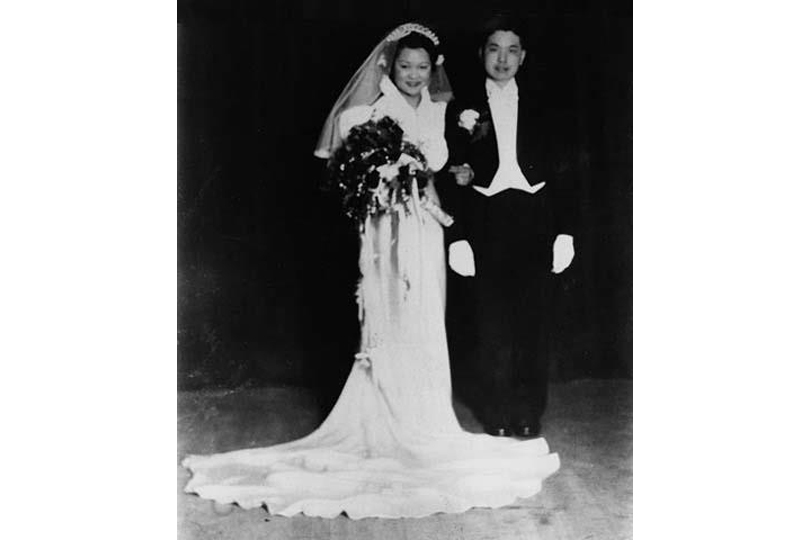
In 1939, Lumb married Doyle Jenning Lumb, and together they would eventually raise six children. Marriage also produced one of the stranger contradictions of her life. Under the nationality laws then governing married women, she lost her Canadian status after marrying Doyle even though she had been born in Canada, because he had been born in China. She would not regain her Canadian status until 1947. It was an indignity that seems almost prophetic when viewed from the other end of Lumb’s life.
The only woman in the room
The Chinese Exclusion Act was finally repealed in 1947, but repeal did not suddenly make Canada’s immigration system equitable. Restrictions continued to prevent many Chinese Canadians from bringing relatives into the country, leaving husbands separated from wives and parents from children. For Lumb, who had grown up as one of 12 children and was now raising a large family of her own, those separations were difficult to ignore.
A national campaign for family reunification was underway, and in 1957 Lumb joined a Chinese Canadian delegation travelling to Ottawa to lobby the federal government for changes to immigration regulations. She was the only woman—an easy detail to glide past now, but at the time, Lumb understood its significance. She was entering a political conversation dominated by men, representing families whose lives had been shaped by policies largely created by men, at a time when women—particularly Chinese Canadian women—had remarkably little access to political power.
During one meeting, circumstance put her directly beside then-Prime Minister John Diefenbaker—seated on the side of his better ear. When he had difficulty hearing parts of the delegation’s presentation, Lumb, who knew the material, found herself repeating portions of it for him. Suddenly, the only woman in the delegation had become one of its most visible voices.
Lumb later remembered that many of the questions were directed toward her because she was a woman and the issue at hand was family reunification. She welcomed the opportunity; women, she believed, had spent too much time in the background. The campaign helped bring changes that broadened the ability of Chinese Canadians to reunite with family members, and for a woman who would eventually accumulate an extraordinary list of honours and accomplishments, Lumb considered that work among the most important of her life.
Two years later, she opened the restaurant that would place her at the centre of another fight.
A seat at the table
In 1959, Lumb and her husband opened Kwong Chow Chop Suey House at 126 Elizabeth Street, in the heart of Toronto’s original Chinatown. The second-floor restaurant became one of the neighbourhood’s best known, popular with Chinese and non-Chinese diners alike, and remembered as one of Toronto’s early restaurants serving dim sum. Lumb didn’t confine her promotion of Chinese food to Kwong Chow: she appeared on television and radio and gave public cooking demonstrations, using food as a way to introduce Chinese culture to Canadians who might otherwise have had little contact with it.
It was a role for which her personality seems to have been particularly well suited. Writer and broadcaster Pierre Berton, one of the restaurant’s patrons, remembered Lumb as a lively and gracious hostess. Kwong Chow attracted politicians, journalists, businesspeople and other prominent Torontonians, but her ability to welcome people into the restaurant was about more than cultivating a fashionable clientele. Lumb cultivated relationships, and conversations about the issues facing Chinese Canadians took place around the restaurant’s tables. She was comfortable speaking to people in positions of authority, while Kwong Chow gave her something Chinese Canadian women rarely possessed at the time: access.
For generations of Chinese Canadians, restaurants had occupied a complicated place in Canadian life. Discrimination had shut Chinese workers out of many professions, pushing some toward businesses such as restaurants and laundries, and prejudice followed them there. Ontario once prohibited white women from working in Chinese-owned restaurants, legislation fuelled by racist fears surrounding Chinese men. Yet restaurants also became places where Chinese and non-Chinese Canadians regularly encountered one another. Lumb understood the possibilities of that exchange. For her, food wasn’t simply a livelihood; it could be a way of sharing culture and changing perceptions.
There is a striking contradiction in what happened next: Toronto was learning to love Chinese restaurants at almost exactly the same moment it was tearing Chinatown down.
The woman who helped save Toronto’s Chinatown
Toronto’s first Chinatown had developed around Elizabeth Street and the surrounding blocks near what is now Nathan Phillips Square. It wasn’t merely a restaurant district. Grocery stores, laundries, community associations, theatres, newspapers, churches and other services created a cultural and economic centre for Chinese Canadians who frequently faced exclusion elsewhere. Then came Toronto’s postwar drive toward urban renewal. Properties were expropriated for the city’s new civic centre, and by the time City Hall opened in 1965, much of the original Chinatown had disappeared. What remained survived in the shadow of the striking new building that had helped displace it.
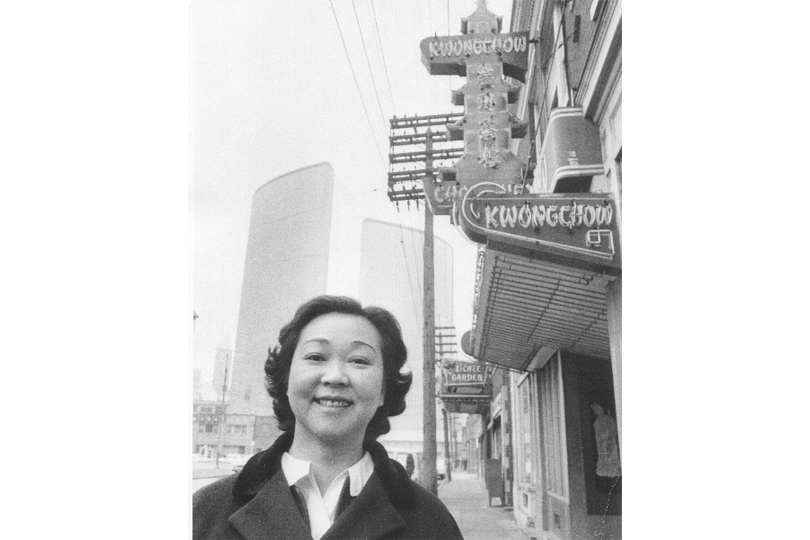
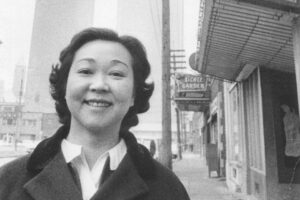
A photograph taken in 1967 captures the contradiction almost perfectly. Lumb smiles for the camera as she stands outside Kwong Chow among the old storefronts of Chinatown, while New City Hall looms over the neighbourhood: one woman, one community, and a monument to the city rapidly replacing it.
When further development threatened the surviving Chinatown, Lumb became one of the central figures in the campaign to stop it. Through the Save Chinatown Committee, she and other community leaders mobilized Chinese organizations and appealed directly to politicians and the wider Toronto public. Their argument was bigger than nostalgia. Chinatown was a thriving commercial district and cultural centre, but, more importantly, it was home. Lumb and her fellow campaigners challenged the assumption that modernization required erasing the people and places that had helped build the city in the first place.
Lumb was uniquely suited to make that argument. For years, she had been inviting Toronto into her restaurant. She knew politicians personally, understood business and could speak as an entrepreneur, a mother, a Chinese Canadian and a woman who had watched her community fight for acceptance in a country that had once actively tried to exclude it. She also understood something Toronto’s planners had overlooked: cities don’t derive their identities solely from the new things they build; they also derive them from the communities they choose not to destroy.
The campaign succeeded in preventing the wholesale demolition of what remained of the neighbourhood. It wasn’t a perfect victory. Much had already vanished, and Toronto’s Chinese commercial and cultural centre was increasingly shifting west toward Spadina Avenue and Dundas Street, where today’s downtown Chinatown would flourish. But the principle Lumb fought for endured: Chinese Canadian history belonged in Toronto’s future.
A proud Canadian
Lumb’s activism was never defined solely by opposition. She was deeply engaged with Canadian civic life, even though she understood firsthand how imperfectly the country had treated people like her. Her response wasn’t to turn away from Canada, but to demand more from it.
Her community work eventually stretched far beyond Chinatown, including appointments to the boards of Women’s College Hospital and University Settlement House and to the Ontario Advisory Council on Multiculturalism. She also spent decades promoting Chinese culture through organizations such as the Women’s Association of the Chinese Dramatic Society and the Chinese Community Dancers of Ontario.
In 1976, Lumb was appointed a Member of the Order of Canada for her contributions to Toronto’s Chinese community, becoming the first Chinese Canadian woman and first restaurateur to receive the honour. The girl who had left school at 12 was now being formally recognized by the country whose laws had once excluded people like her.
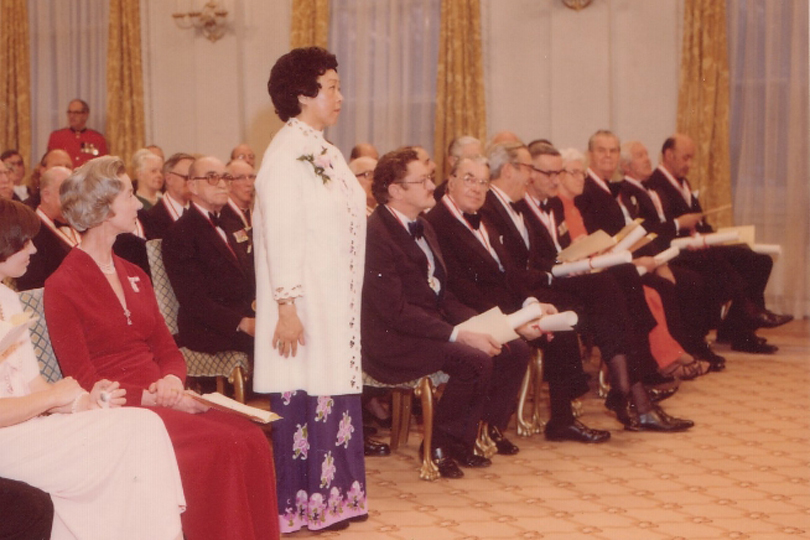
But the most poetic chapter was still to come. In 1994, when Lumb was in her mid-70s, she became a Canadian citizenship judge and, for the next several years, presided over ceremonies welcoming immigrants as new Canadian citizens. Consider the journey embedded in that moment: Lumb had been born into a Canada that passed the Chinese Exclusion Act when she was four; she had lost her own Canadian status after marrying a Chinese-born man; she had watched families remain separated by immigration restrictions and travelled to Ottawa as the only woman in a delegation asking the federal government to change them; and she had watched much of Toronto’s first Chinatown disappear beneath the city’s vision of progress before helping fight to preserve what remained. Now she was standing before rooms filled with newcomers and welcoming them into Canada.
Lumb continued serving as a citizenship judge until 2001 and died the following year, on July 17, 2002, just shy of her 83rd birthday. Today there are plaques, awards and a Toronto laneway bearing Jean Lumb’s name. The Jean Lumb Foundation, established by family and friends, continues her legacy by recognizing young Canadians of Chinese heritage, while her daughter Arlene Chan has spent decades documenting and preserving the history of Toronto’s Chinese community. But Lumb’s legacy also exists in places that don’t carry her name.
Stand in Nathan Phillips Square today and there is little indication that much of Toronto’s first Chinatown once occupied the surrounding streets. The square is now so central to the city’s identity that it can seem inevitable, as though Toronto had always looked this way. It didn’t. Communities existed there, families built lives there and businesses flourished there. When the city decided that what remained of Chinatown might also need to disappear, Lumb helped convince Toronto that progress didn’t have to mean erasure.
Her life repeatedly returned to that same fundamental idea: there should be room. Room for Chinese families to be reunited, room for a woman to speak when she was the only woman at the table, room for an immigrant community to retain a physical place in a changing city, room for Chinese culture within Canadian culture and, eventually, room for generations of newcomers to call Canada home.
For a woman who so often found herself the only woman in the room, Jean Lumb spent an extraordinary amount of her life making room for those who came after her.
Trending










![Everything You Need To Know About Netflix’s ‘Monster: The Lizzie Borden Story’ [UPDATED]](https://29secrets.com/wp-content/uploads/2026/08/Everything-You-Need-To-Know-About-Netflix-Monster-The-Lizzie-Borden-Story-HEADER.jpg)