
Part of an ongoing series of 29Secrets stories, taking a deep dive into the history of legendary beauty products and iconic fashion moments…
By Christopher Turner
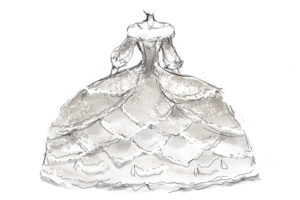
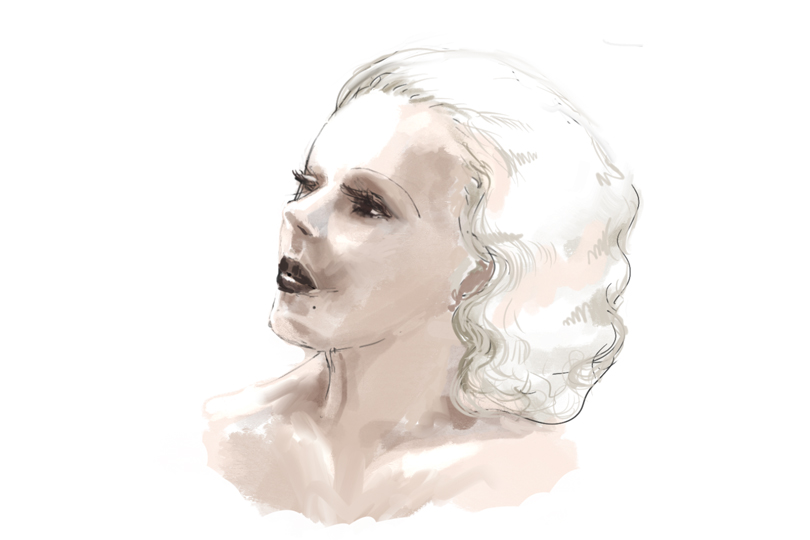
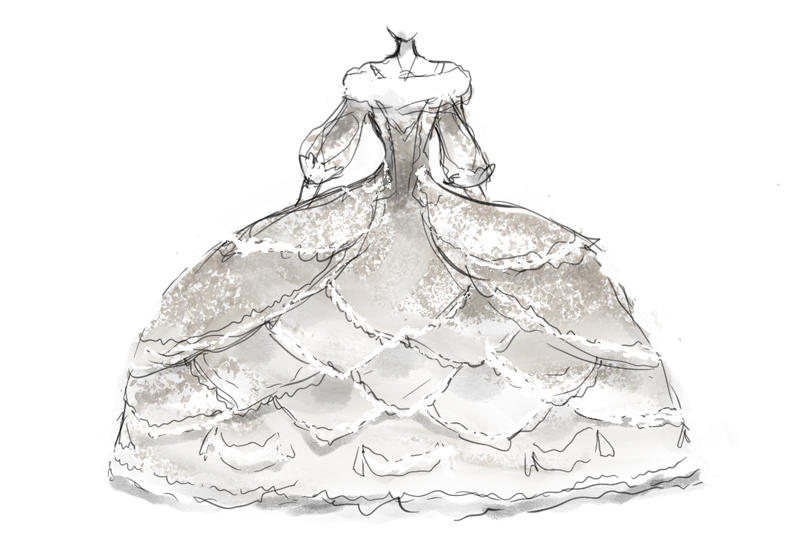
Illustration by Michael Hak
Marie Antoinette’s complicated relationship with France began with an extravagant dress that didn’t fit.
On the morning of May 16, 1770, the Palace of Versailles in France glittered with silver, gold and diamonds as members of Europe’s royal and aristocratic elite gathered to witness a marriage intended to cement one of Europe’s most consequential political alliances. Every detail had been rehearsed, the procession had been choreographed, and every ribbon, jewel and embroidered thread had been chosen specifically to communicate the magnificence of the French monarchy.
Only one thing refused to co-operate. The bride’s wedding dress wouldn’t close.
Somewhere between Vienna and Versailles, the measurements for the 14-year-old Austrian archduchess had gone wrong. The magnificent white and silver gown waiting for her at court was too small across the back, leaving her attendants scrambling to disguise a visible gap in one of the most important garments in Europe. There was no time for alterations. The future queen of France walked toward the altar knowing that her dress—the very symbol of dynastic perfection—had already failed her.
For generations, historians have treated the wardrobe malfunction as an irresistible metaphor. The Austrian princess who would spend much of her life struggling to belong in France arrived wearing a gown that couldn’t quite accommodate her. Whether coincidence or symbolism, the image has endured for more than 250 years.
But the story of Marie Antoinette’s wedding dress is about far more than an ill-fitting bodice. It is the story of how clothing became diplomacy, how fashion transformed a teenage girl into a political symbol, and how one extraordinary gown marked the beginning of one of history’s most complicated relationships between a woman, a country and her wardrobe.
Long before powdered wigs and towering hairstyles made her the ultimate fashion icon of the late 18th century, Marie Antoinette was simply Maria Antonia, the 15th child and youngest daughter of Emperor Francis I and Empress Maria Theresa of Austria.
Before she was Marie Antoinette
Maria Antonia was born on November 2, 1755, at the Hofburg Palace in Vienna, Austria, and by right of her birth, she was an Austrian archduchess of the House of Habsburg-Lorraine. She grew up surrounded by imperial splendour, but also by an uncomfortable reality: royal daughters were political assets. Maria Theresa famously arranged marriages across Europe to strengthen the Habsburg Empire, and her youngest surviving daughter would become one of her most valuable diplomatic assets.
For centuries, Austria and France had been bitter enemies. But the so-called Diplomatic Revolution of 1756 upended European politics, transforming rivals into uneasy allies. And a royal marriage offered the perfect solution to strengthen that new alliance.
Maria Antonia’s husband, the future Louis XVI of France, was chosen before she was old enough to understand what the prospect of marriage meant.
Maria Antonia was only 14 years old at the time, and the future Louis XVI, then known as Louis-Auguste, was only 15. Their arranged marriage had nothing to do with romance and everything to do with stability, as the two teenagers were tasked with embodying the hopes of two kingdoms.
But before Maria Antonia could marry France’s future king, she first had to become French herself.
The day Maria Antonia was stripped of Austria
If Marie Antoinette’s wedding dress symbolized her arrival in France, another outfit symbolized the end of her old life.
In early May 1770, after weeks of travelling from Vienna, Maria Antonia reached the Rhine River near Strasbourg. Waiting on a tiny island between Austria and France was an elegant wooden pavilion built for a single ceremony known as the remise—the formal handover of the bride.
Inside, one of history’s most extraordinary fashion rituals unfolded.
Maria Antonia was required to surrender everything Austrian as her ladies-in-waiting remained behind. When her carriage crossed over from her native Austria into France, Maria Antonia was taken out, stripped naked before an entourage, and dressed in French attire to please the court of her new king.
She entered the pavilion wearing Austrian dress. She left wearing French silk.
It was political theatre at its most literal. Before crossing into France, the young archduchess was stripped of her nationality through clothing. The message was unmistakable: nothing Austrian—not even the fabric touching her skin—was permitted to accompany the future dauphine into her new country.
Symbolically, Maria Antonia had disappeared. When she emerged, she belonged to France as Marie Antoinette, its new dauphine.
It remains one of the most remarkable examples of fashion functioning as statecraft. A wardrobe change became a national transformation.
Versailles spoke through clothes
To understand Marie Antoinette’s wedding gown, you first have to understand Versailles.
At Louis XV’s court, clothing wasn’t simply beautiful; it was bureaucratic. Dress announced hierarchy before anyone spoke. Everything about it—the width of a train, the quality of lace, the brilliance of embroidery and even who was permitted to help a royal woman dress—was governed by etiquette so complex it bordered on choreography.
Formal court dress followed rigid conventions. The most ceremonial style, known as the grand habit, featured an extraordinarily structured bodice, enormous panniers extending dramatically from either side of the hips and a sweeping train designed less for movement than for spectacle.
These dresses weren’t meant to flatter the body in a modern sense. They transformed women into architectural monuments of silk and embroidery.
For a royal wedding, nothing less would do.
Strict protocol governed wedding attire for the bride of a French heir to the throne. For the ceremony, Marie Antoinette appeared in an extravagant gown given to her by her mother, Empress Maria Theresa of Austria.
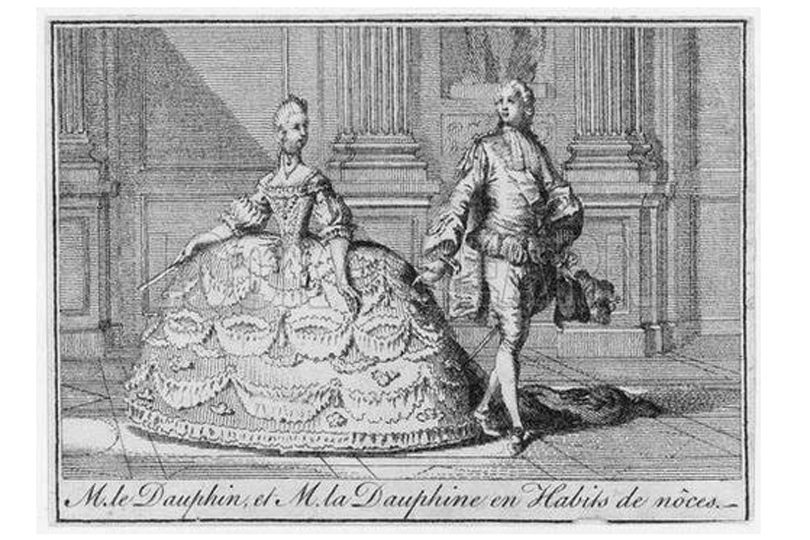
Curiously, one of history’s most famous royal gowns no longer exists.
According to archival accounts and fashion historian Caroline Weber, who wrote the 2007 book Queen of Fashion: What Marie Antoinette Wore to the Revolution, Marie Antoinette’s wedding dress disappeared during the upheaval of the French Revolution, when much of the royal wardrobe was looted, dismantled or sold. “There’s literally not a single entire gown that survives,” according to Dr. Sarah Grant, who curated the V&A’s massive “Marie Antoinette Style” exhibition in London, England, in 2025. After the Revolution, “her wardrobe was looted, pieces were cut up and sold, and everything was dispersed.”
As a result, unlike other famous royal wedding dresses, such as the satin with tulle wedding dress that Queen Elizabeth II wore to marry Prince Philip in 1947, or the elaborate ivory silk taffeta and antique lace gown designed by David and Elizabeth Emanuel and worn by Diana, Princess Of Wales, in 1981, Marie Antoinette’s bridal look survives only through portraits, written descriptions and contemporary accounts.
That absence has only deepened its mythology.
However, historians agree the gown was made from shimmering silver cloth woven with metallic threads—a fabric reserved for the highest levels of European royalty. It was worn over vast panniers that stretched the skirt horizontally while leaving the front remarkably flat, creating the unmistakable silhouette of 18th-century French court dress. The neckline sat low across the shoulders, framed by delicate lace, while the bodice was stiff enough to sculpt the teenage bride into the idealized posture expected of a dauphine. A magnificent train followed behind her, and contemporary observers marvelled at the extraordinary quantity of diamonds adorning the young princess.
One English duchess wrote that the bride seemed almost buried beneath jewels.
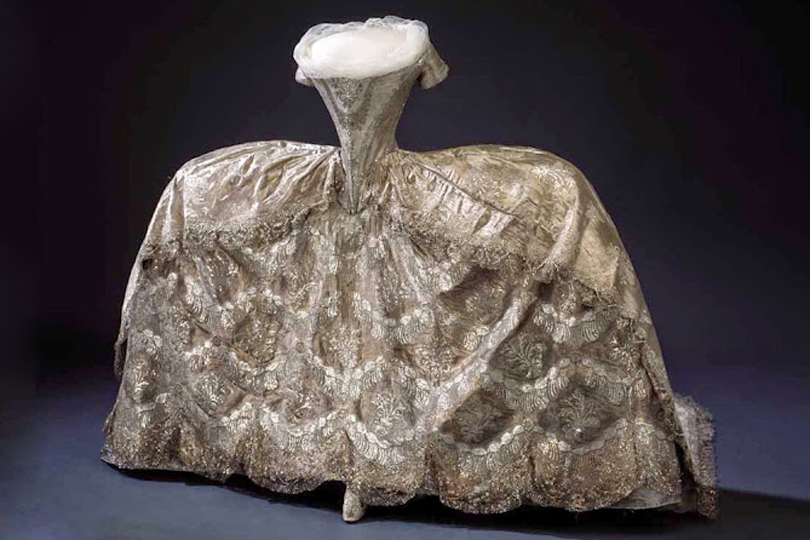
While Marie Antoinette’s gown has vanished, a remarkably similar royal wedding dress survives. The silver court gown worn by Duchess Hedvig Elisabet Charlotta of Holstein-Gottorp for her 1774 marriage to the future Charles XIII of Sweden offers a rare glimpse of the extraordinary silhouette Marie Antoinette would have worn just four years earlier: an impossibly narrow bodice exploding into enormous panniers, metallic fabric shimmering across its surface and a ceremonial train sweeping behind. Today the rare silver-threaded brocaded silk gown worn by the Duchess (later Queen of Sweden) is featured in major international showcases on Marie Antoinette’s legacy.
“It’s as close as we can get to seeing what Marie Antoinette would have looked like on her wedding day,” said Grant.
It’s tempting to picture the exuberant Marie Antoinette as immortalized in Sofia Coppola’s 2006 film of the same name, with Kirsten Dunst buried beneath towering powdered hair, feathers and ribbons. But the real bride who walked through Versailles in 1770 looked considerably younger and more restrained.
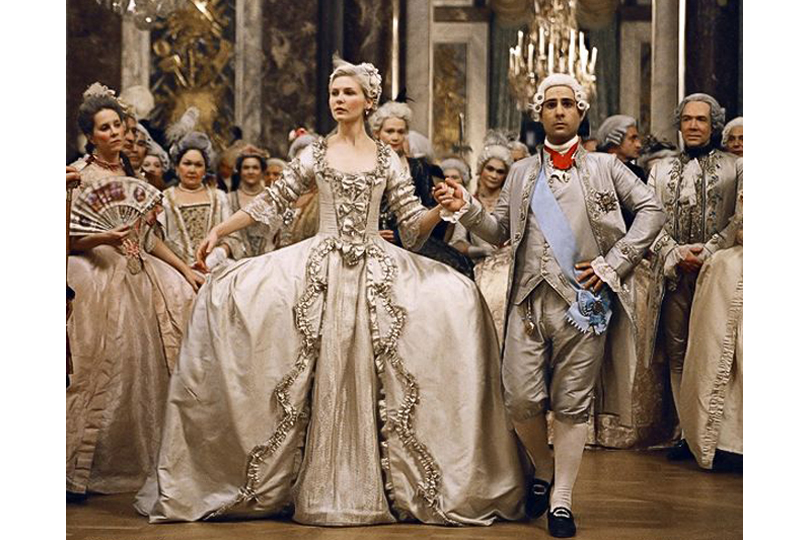
She wasn’t yet the Queen of Fashion. She was simply a girl wearing an astonishing number of jewels.
The wardrobe malfunction that became legend
For centuries, every description of Marie Antoinette’s dress has been overshadowed by one detail: the dress didn’t fit.
According to fashion historian Weber as well as archival accounts, the gown had been made in Vienna without the benefit of proper final fittings. Whether Marie Antoinette had grown since her measurements were taken or the dressmakers simply miscalculated, the result became legendary: when her attendants attempted to dress her for the ceremony, the two sides of the bodice refused to meet.
Normally, the lacing beneath a court gown would have been completely concealed. Instead, no matter how tightly her attendants tried to cinch the gown, the lacing and shift beneath remained visible through a conspicuous gap at the back. With no time to remake the bodice, Marie Antoinette had little choice but to proceed to the chapel partially unlaced.
At a court obsessed with appearances, the mistake must have been mortifying.
The wedding that united two kingdoms
The wedding of Marie Antoinette and the Dauphin Louis-Auguste took place on May 16, 1770, at the Palace of Versailles in Versailles, France. The two teenagers had met for the first time just two days before the ceremony.
At one o’clock in the afternoon, Marie Antoinette entered the King’s Cabinet at the palace, dressed in her enormous court dress and covered in a dazzling display of diamonds and jewels befitting the future queen of France. Louis-Auguste was already there, dressed magnificently in shimmering gold cloth and wearing the dazzling regalia of the Order of the Holy Spirit. Louis-Auguste took his bride-to-be’s hand and, together, they processed through the glittering State Apartments toward the Royal Chapel of Versailles for the wedding rite itself.
Contemporary accounts portray the nervous teenage groom as blushing and trembling throughout the ceremony. The Archbishop of Reims blessed the union while Europe’s diplomatic elite watched two children promise themselves to one another on behalf of their respective nations.
The ceremony itself lasted barely an hour, but its political significance was immeasurable.
Outside the chapel, celebrations stretched for days. Banquets filled Versailles. Performances inaugurated the magnificent new Royal Opera. Fireworks lit the skies over Paris. The marriage wasn’t merely a family celebration—it was a public declaration that France and Austria were entering a new era together.
Tragically, however, even the festivities produced disaster. During the Paris fireworks display, panic erupted among the enormous crowds gathered in the Place Louis XV, killing more than a hundred people. Later generations would interpret the catastrophe as yet another omen surrounding the marriage.
History has always been eager to foreshadow Marie Antoinette’s fate.
Becoming the best-dressed woman in Europe
The irony is almost poetic. The girl whose wedding gown became famous for fitting badly would eventually become the most influential dresser of the 18th century.
As Queen of France, Marie Antoinette transformed fashion into personal expression. Working with celebrated dressmaker Rose Bertin and legendary hairdresser Léonard Autié, she abandoned the visual restraint expected of young royalty and embraced theatricality. Hairstyles climbed impossibly high. Silk flowers bloomed across powdered wigs. Feathers, ribbons and extravagant trims turned Versailles into a living runway.
European aristocrats copied her relentlessly.
From London to Vienna and St. Petersburg, aristocratic women watched—and copied—what Marie Antoinette wore. And, for perhaps the first time in modern history, a queen became an international fashion influencer.
Yet the same clothes that elevated her also became ammunition for critics who portrayed her wardrobe as evidence of frivolity during a period of financial crisis. Political pamphlets exaggerated her spending until luxury itself became inseparable from her reputation. Her Austrian birth only intensified the hostility, earning her the cruel nickname L’Autrichienne—a pun recalling the French word chienne (a female dog, or bitch), that turned “Austrian woman” into an insult.
Even simplicity became controversial. When Élisabeth Vigée Le Brun painted the queen in a loose white muslin gown in 1783, critics erupted with outrage, arguing the queen looked as though she’d appeared publicly in her underwear.
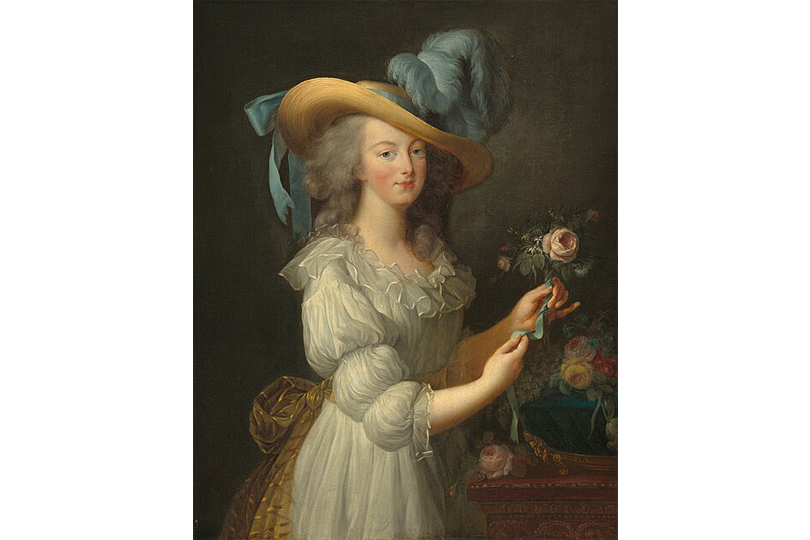
Marie Antoinette could not win: too elaborate, she was decadent; too simple, she was improper. Fashion had become a prison disguised as privilege.
Why the wedding dress still matters
Marie Antoinette’s wedding gown is one of fashion history’s great ghosts.
Unlike so many iconic garments preserved behind museum glass, it survives only in fragments of historical descriptions and collective imagination. We know its silver brilliance, its extraordinary silhouette, its diamonds and, perhaps most vividly, about the opening down its back.
That tiny imperfection has outlived the dress itself.
Perhaps that’s because it reveals something unexpectedly human behind the image of one of history’s most mythologized women. Before she became the queen caricatured for excess, before the powdered wigs and scandalous portraits, before the French Revolution and before her death by guillotine on October 16, 1793, at the age of 37, she was simply a 14-year-old girl walking into an unfamiliar country wearing a dress that made her feel exposed.
Her wedding gown was designed to announce certainty. Instead, it revealed vulnerability.
More than 250 years later, that’s what continues to make it unforgettable. Not because it was flawless, but because it wasn’t. In the smallest failure of its stitching lies the beginning of one of history’s most extraordinary stories about fashion, identity and the impossible weight a dress can be asked to carry.
Want more? You can read other stories from our The Story Of series right here.
Trending
 10 Memorable Images Of Supermodel Gia Carangi (1960–1986)
  20 Celebrities Who Posed For Abercrombie & Fitch Before They Were Famous
  ‘Project Runway Canada’ Seamlessly Struts Back With New Season
  Fragrance Of The Month: The 7 Virtues Blackberry Lily
  THE STORY OF: Madonna’s Iconic Jean Paul Gaultier Cone Bra