
By Christopher Turner
This week, an American Eagle ad campaign featuring Sydney Sweeney sparked controversy and drew criticism for its double entendre-laden tagline, “Sydney Sweeney has great jeans.” In one of the campaign videos, a reclining Sweeney buttons up her jeans as the camera pans up her body and she speaks in a matter-of-fact tone, saying, “Genes are passed down from parents to offspring, often determining traits like hair colour, personality and even eye colour. My jeans are blue.”

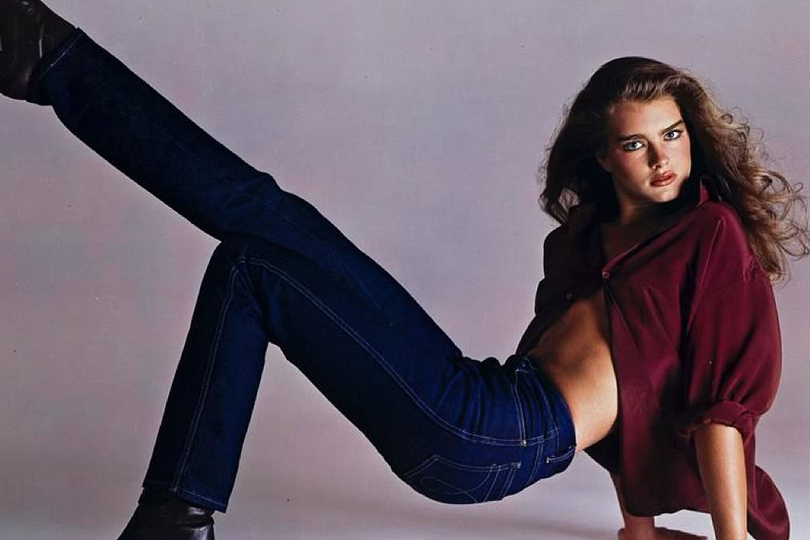
Some critics have argued that an allusion to “great genes” in an ad featuring a blond-haired, blue-eyed woman felt like a reference to eugenics. Aside from American Eagle’s questionable marketing campaign, the jeans ad is also earning scrutiny for its alleged similarities to the famous 1980 Calvin Klein ad, featuring Brooke Shields, which drew extreme controversy at the time for its perceived sexual tone.
At the time of Shields’ ad, the campaign, especially the television commercial, sparked controversy by having the then-15-year-old model recite the ambiguous brand tagline: “You want to know what comes between me and my Calvins? Nothing.”
Here’s a look back at Calvin Klein’s “Nothing Comes Between Me and My Calvins” print and TV ad campaign starring Brooke Shields, and the controversy that defined it.
The making of a provocation
The early 1980s were a turning point for designer denim. Calvin Klein, who had already revolutionized the industry with his tailored, minimalist looks in the 1970s, was ready to make his mark in the more casual realm of jeans. But Klein wasn’t interested in denim as utility wear; he wanted to turn it into a symbol of sexual allure and high fashion.
Enter Richard Avedon, the legendary fashion photographer known for his emotionally charged, high-contrast images. With him came a then-teenage Brooke Shields, already a rising star thanks to her role in the controversial film Pretty Baby (1978), which was directed by Louis Malle and written by Polly Platt, and featured Shields as a 12-year-old girl who was being raised by her prostitute mother in a brothel in the red-light district of New Orleans. The film sparked a storm of controversy over age, consent and exploitation. Even People magazine jumped in on the controversy with their May 29, 1978, issue, which featured Shields on the cover and bore the headline “Brooke Shields, 12, stirs furor over child porn in films.”
The Calvin Klein ad campaign was minimal in production but maximal in impact. Set against stark backdrops and scored to throbbing music in the television ads, it showed Shields delivering her now-famous line while reclining, stretching or dancing in tight-fitting denim. The implication was not subtle. And that was exactly the point.
“You want to know what comes between me and my Calvins?”
In the fall of 1980, a fresh-faced 15-year-old Shields stared into the camera with a disarming confidence far beyond her years. Dressed in form-fitting denim and framed by a sultry gaze, she purred a single, now-immortal line: “You want to know what comes between me and my Calvins? Nothing.” (The famous line is often misquoted as “Nothing comes between me and my Calvins.”)

It was a campaign that exploded into the American consciousness with the force of a cultural earthquake. It launched Calvin Klein jeans into the stratosphere, solidified Shields as a household name, and ignited a firestorm of controversy that questioned the boundaries between fashion, advertising and the sexualization of young girls. Forty-five years later, it remains one of the most provocative – and pivotal – moments in fashion history.
Selling sex – and denim
The Calvin Klein denim ads ran on national television and in glossy magazines, and almost immediately, they became a national talking point. On the surface, the message was simple: Calvin Klein jeans were sexy, and Brooke Shields was the embodiment of their cool, unattainable appeal. But America, especially conservative groups and parents, heard something else: a 15-year-old girl being used to sell sex.
Women’s groups, parenting organizations and television watchdogs decried the campaign as exploitative and obscene. The television commercial made its debut on November 20, 1980 and CBS and ABC refused to air the commercials altogether, while others allowed them to air only after 9:00 pm. Public figures like Reverend Donald Wildmon of the National Federation for Decency called for a boycott of Calvin Klein products, accusing the brand of “mainstreaming pedophilia.”
And yet, even as the backlash mounted, so too did sales. Calvin Klein’s jeans flew off the shelves. Within weeks, they had become one of the most desired pieces of clothing in America. By the end of the year, the campaign had helped the brand sell more than 200,000 pairs of jeans in a single week.
Brooke Shields, America’s lightning rod
Caught in the eye of the storm was Shields herself. At 15, she was already no stranger to controversy. Her mother and manager, Teri Shields, had long been criticized for allowing her daughter to take on adult roles and model in provocative ways. In Pretty Baby, The Blue Lagoon, and now the Calvin Klein campaign, Shields was simultaneously lionized and vilified – praised for her poise and beauty, and scrutinized for the adult content in which she appeared.
In later interviews, Shields has repeatedly insisted that she didn’t understand the innuendo of the ads when they were filmed.
Shields told Vogue in October 2021 that she thought the backlash, which centred on the alleged sexualization of an underage Shields, was “ridiculous.”
“I was naive, I didn’t think anything of it. I didn’t think it had to do with underwear, I didn’t think it was sexual in nature. I would say it about my sister, ‘Nobody can come between me and my sister,’” she explained.
The actress also recalled being shocked that she was being “berated” by the public, who assumed she knew the intention behind the commercials. “I think the assumption is that I was much more savvy than I ever really was.”
For many critics, that made it all the more troubling. Shields was seen as the poster child of an industry that commodified youth and blurred ethical boundaries in the name of glamour.
But to others, Shields was also emblematic of a new kind of American celebrity: one whose innocence and sexuality were in constant tension, who was made not just by Hollywood or fashion, but by the cultural wars themselves.
Calvin Klein: Provocateur or visionary?
For Calvin Klein, controversy wasn’t a side effect – it was strategy. The designer had long played with taboo in his advertising, from the steamy embrace of a naked couple to his later, eerily voyeuristic campaigns in the 1990s that would again ignite debates about taste and decency.
“I’ve always felt that my advertising was about ideas, not just about clothes,” Klein said in a rare 1981 interview. “If we’re not saying something with our images, then what’s the point?”
The Brooke Shields ad campaign was certainly saying something – loudly. It was about rebellion, youth, beauty and danger. And like the best advertising, it didn’t just reflect culture; it shaped it.
A cultural mirror—and a warning
In retrospect, the campaign can be read as a perfect mirror of America at a tipping point. The Ronald Reagan era had just begun, ushering in a decade defined by conservatism, yet rife with contradictions – one where MTV and Madonna co-existed with censorship campaigns and “family values.”
The Shields campaign revealed how fashion could be both liberating and destructive. It gave young women a new icon of beauty and self-assurance, while also exposing the disturbing ways in which that confidence was often manufactured and consumed. It challenged the boundaries between adolescence and adulthood, commerce and art, expression and exploitation.
Today, the ad is both reviled and revered. It appears in museum retrospectives, pop culture documentaries and fashion history books. For some, it represents the worst instincts of an industry willing to sexualize minors for profit. For others, it’s a relic of a time when fashion dared to provoke, to scandalize, to make people uncomfortable.
Shields went on to attend Princeton University, star in Broadway plays and become an advocate for mental health and women’s rights. She has spoken openly about the complexities of her early fame, the pressure to be perfect, and the blurry lines between empowerment and objectification.
Calvin Klein, for his part, continued to push buttons until his retirement from design in 2003. The brand, now owned by PVH Corp, still evokes the sensual minimalism that Klein pioneered, though its shock tactics have softened in the digital age.
And the jeans? They’re still iconic – and forever linked to that one unforgettable line that ultimately changed the future of advertising. It’s a line that has echoed through the decades, and has been parodied, criticized and remembered. In twelve words, it encapsulated not just a marketing master stroke, but a moment when America had to ask itself: What are we really selling – and at what cost?
In the end, the Brooke Shields Calvin Klein campaign wasn’t just about denim. It was about desire, danger and the uncomfortable intersection of youth, fame and fashion. And nothing – absolutely nothing – has come between us and that cultural moment since.
RELATED:
Trending
 Here’s Every Song From ‘Love Story: John F. Kennedy Jr. & Carolyn Bessette’ [UPDATED]
  This 100-Year-Old Cult Beauty Hero Belongs On Every Top Shelf
  A Short History Of ‘George’: John F. Kennedy Jr.’s Magazine That Was Ahead Of Its Time
  10 Memorable Images Of Supermodel Gia Carangi (1960–1986)
  A Look Back At Benetton’s Most Controversial Advertising Campaigns