
By Christopher Turner
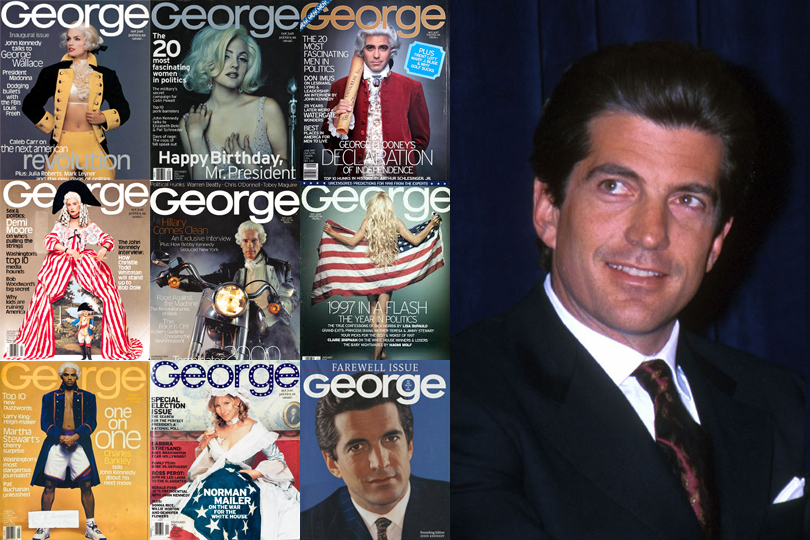
In September 1995, newsstands across North America displayed something that felt both wildly unexpected and strangely inevitable: a glossy political magazine founded by John F. Kennedy Jr., the most famous political heir of his generation. The publication was called George—named after George Washington—and its tagline declared its mission with quiet audacity: “Not Just Politics As Usual.”
The debut cover alone received unprecedented coverage, signalling that this was no ordinary magazine launch. Supermodel Cindy Crawford (photographed by famed fashion photographer Herb Ritts) appeared dressed as George Washington in a cropped colonial jacket, merging political iconography with high fashion in a way that readers had never really seen before. The debut issue was provocative, glamorous, and impossible to ignore—much like Kennedy himself, who dominated the headlines at the time thanks to his relationship with Carolyn Bessette. Within months, George would become one of the most talked-about magazines of the decade, a cultural experiment that attempted to merge politics, celebrity and lifestyle culture long before social media made such blending inevitable.
But the story of George is not simply about a magazine. It’s also about media evolution, and the complicated legacy of a man born into American mythology.
The man behind the magazine
John F. Kennedy Jr. was born on November 25, 1960, in Washington, D.C., at Georgetown University Hospital. Born just over two weeks after his father’s election, he was the son of the 35th U.S. president, John F. Kennedy, and First Lady Jacqueline Kennedy. He was the first child ever born to a president-elect in the modern era.
Kennedy spent his first years in the spotlight, living in the White House until his father was assassinated while riding in a presidential motorcade through Dealey Plaza in Dallas, Texas, on November 22, 1963. The president was in the vehicle with his wife (who was famously wearing a pink Chanel suit), Texas governor John Connally, and Connally’s wife Nellie, when he was fatally shot from the nearby Texas School Book Depository by Lee Harvey Oswald, a former U.S. Marine. At 12:30 pm, three gunshots were heard. Two bullets struck the president’s neck and head, and he slumped over toward his wife, while a third bullet hit Connally in the back. The president was pronounced dead at 1:00 pm in a historic announcement that stunned the United States and, indeed, the world.
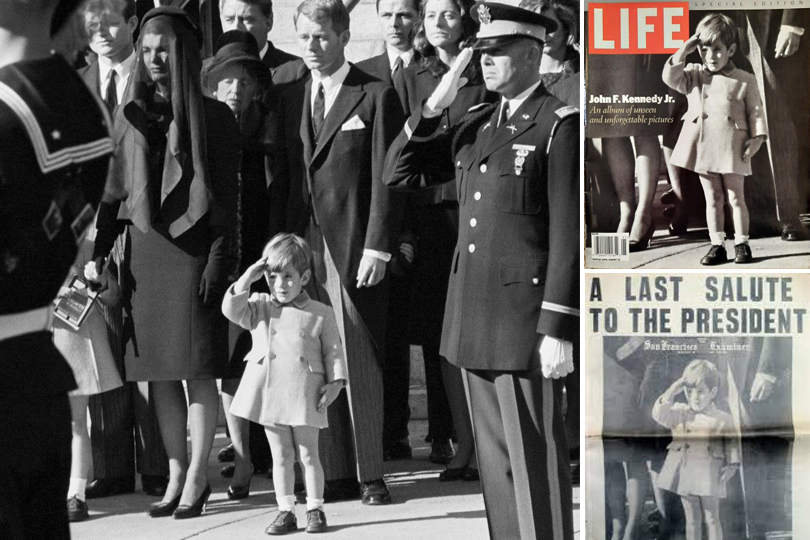
On November 25, 1963, President Kennedy was laid to rest in Arlington National Cemetery, with heads of state and representatives from more than 100 countries attending, and with untold millions more watching on television. At the funeral procession, which took place on Kennedy’s third birthday, he gave his father’s flag-draped casket a final salute as it went past him. The haunting image of Kennedy as a child would follow him for the rest of his life, and would go on to become one of the most famous photographs in American history.
Reinventing politics for the MTV Generation
John F. Kennedy Jr. graduated from Brown University in 1983 with a bachelor’s degree in American studies. He worked for the New York City Office of Business Development and later the 42nd Street Development Corporation, eventually earning a law degree from New York University in 1989. That same year, he became an assistant district attorney in Manhattan, where he worked for nearly four years. He was sworn in during August 1989 after graduating, and remained in office while he took the New York bar exam. He failed the bar twice before passing on his third attempt in July 1990. He was allowed to remain in the office during this time, but would have been ineligible to continue as a prosecutor had he failed a third time.
During that time, American politics was undergoing a cultural shift. Cable news had exploded and celebrity culture was slowly intensifying. Just a few years earlier, in 1988, Anna Wintour had shocked the magazine world when she took over the helm of American Vogue—somewhat brutally—replacing Grace Mirabella, the famed fashion editor who had been the magazine’s editor-in-chief since 1971. Wintour revitalized the fashion magazine at lightning speed, kicking things off with a shocking cover in November 1988, and brought a more youthful, approachable edge that was appealing to both readers and advertisers.
Yet despite all this change elsewhere, political magazines remained stubbornly traditional: dense, policy-heavy, insider publications aimed at elites living and working in Washington D.C., and New York. Kennedy saw an opportunity. Working with public relations executive Michael J. Berman, he spent years quietly developing the concept for a flashy political magazine before partnering with publishing giant Hachette Filipacchi Media to launch the magazine. Their goal was radical: treat politics like pop culture, and pop culture like politics.
The editorial model of George borrowed from high-profile glossy lifestyle titles such as Rolling Stone, Vanity Fair and Esquire, but with a civic twist. Instead of reading dry legislative analysis, readers would encounter celebrity interviews about political issues, politicians profiled like movie stars, and cultural commentary that made governance feel relevant to everyday life.
Today, that approach to the world of mainstream magazines feels almost obvious, but in the 1990s, it was pretty revolutionary.
The personal stakes for Kennedy
For Kennedy, George was also deeply personal. As the son of President John F. Kennedy and Jacqueline Kennedy Onassis, he had lived his entire life under public scrutiny. After earning a law degree and working as a prosecutor in New York, he faced constant speculation about whether he would enter politics. Launching a magazine allowed him to engage with public life without formally declaring political ambitions.
In many ways, George became Kennedy’s platform to explore the intersection of fame, power and public service—the very forces that had defined his family history. The magazine’s success also helped him carve out an identity separate from his father’s legacy.
The first issue reportedly sold nearly half a million copies: a remarkable achievement for a political publication. For a moment, it seemed Kennedy had discovered an entirely new media genre.
Celebrity covers, cultural conversations
The covers of George became instant conversation pieces and consistently received media attention. That started with the very first issue, the October/November 1995 issue, with a cover image of Cindy Crawford shot by Herb Ritts.
“JFK Jr. called and asked me to do the first cover of his new magazine,” Crawford reflected in a Facebook post in 2012. “Posing as George Washington sounded weird, but knowing Herb Ritts was going to shoot it reassured me that it would be beautiful. I love how true to George Washington the clothes, hair and pose are, but with midriff! Perfect example of Herb’s sense of humor!”
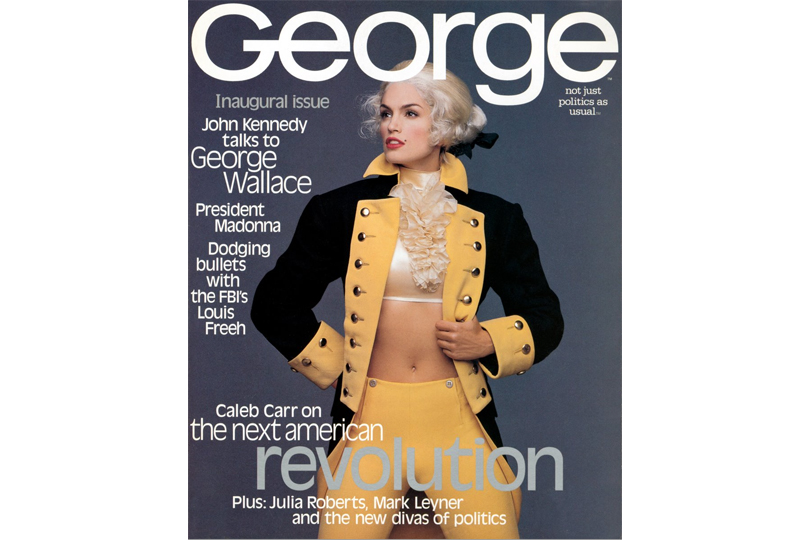
Suffice to say a lot of people were scandalized by the provocative image.
“We’re about the intersection of politics and popular culture. Cindy Crawford is sort of the symbol of American commercialism in a way, as well as being a very capable businesswoman,” Kennedy said on Larry King Live after the October/November 1995 issue hit newsstands, when a viewer asked why he had chosen the image for the cover.
The merging of the two very different worlds didn’t end with the inaugural issue of George. Different actors, musicians, athletes and public figures all appeared styled as political icons or engaged in political themes and the publication featured contributors ranging from journalists and political strategists to comedians and celebrities.
The concept sparked criticism. Some commentators dismissed the magazine as superficial, accusing it of prioritizing glamour over substance. Critics argued it was “politics for people who don’t understand politics,” suggesting it stripped complexity from serious issues.
But supporters countered that accessibility was precisely the point. Kennedy believed civic engagement required making politics interesting—especially to younger readers who felt disconnected from traditional institutions.
Inside the magazine: ambition and conflict
Behind the glossy, attention-grabbing covers, George faced challenges common to ambitious media startups. By 1997, tensions between Kennedy and co-founder Berman escalated into a power struggle that ultimately ended with Berman’s departure from the company. The conflict destabilized the publication at a critical moment, contributing to declining sales and internal uncertainty.
There were also editorial dilemmas. Kennedy aimed to attract younger audiences but sometimes resisted high-profile celebrity interviews that might have boosted circulation, preferring more substantive political figures instead. Publishers worried he was not taking enough commercial risks.
The magazine hovered between two identities: serious political journalism and glossy lifestyle entertainment. That tension—its greatest innovation—was also its greatest vulnerability.
A cultural moment cut short
On July 16, 1999, less than four years after the magazine’s launch, Kennedy died in a plane crash at age 38, alongside his wife, Carolyn Bessette Kennedy, and her sister Lauren Bessette. Kennedy was piloting the light aircraft that evening when it crashed into the Atlantic Ocean off Martha’s Vineyard, Massachusetts. The tragedy shocked the world and instantly transformed Kennedy into a mythic figure of lost potential.
For George, the loss was devastating.
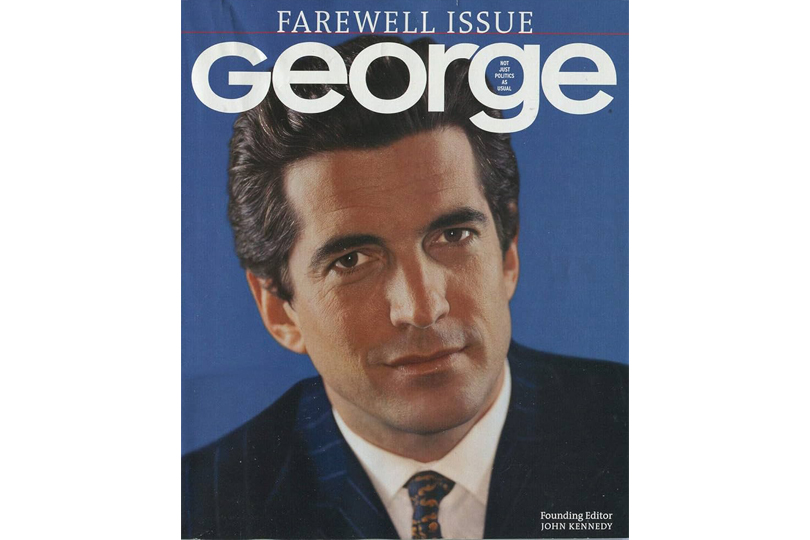
Circulation grew after Kennedy’s death, somewhat morbidly, but advertising revenue did not. Although the publisher continued producing the magazine under new editorial leadership after Kennedy’s death, it struggled without its founder’s charisma and vision. Advertising revenue declined, readership fell, and the publication ultimately ceased operations in 2001, two years after Kennedy’s death. The last issue of George was the January 2001 issue (often referred to as the “Farewell Issue”), which featured a tribute to the publication’s founder.
The magazine’s lifespan had been brief—just six years—but its cultural impact lingered.
Ahead of its time
In retrospect, George looks remarkably prescient. The magazine’s blending of spheres—Hollywood and Washington, entertainment and policy—anticipated the modern era of political branding decades ahead of its time. Today, the boundaries between politics, celebrity and media are nearly nonexistent. Politicians cultivate Instagram personas, appear on late-night talk shows and collaborate with influencers, while viral moments shape campaigns, and entertainment platforms influence elections. Kennedy’s magazine experiment anticipated this transformation long before it became mainstream.
What he attempted in print back when he launched George in 1995 now defines digital political culture.
Similar to how Anna Wintour’s dramatic moves at Vogue shifted the fashion industry, George reflected a broader shift in journalism: the recognition that storytelling, personality and visual culture matter in civic discourse. Kennedy understood that readers connect with narratives, not just policies.
Legacy: Myth, media, and possibility
The legacy of George is inseparable from the legacy of John F. Kennedy Jr. himself. It represents both ambition and unrealized potential—a project that might have evolved dramatically had he lived. Some observers believe Kennedy could have eventually transitioned from media into politics, using George as a stepping stone toward public office.
Instead, the magazine remains a snapshot of a particular cultural moment: the optimism of the 1990s, the glamour of Kennedy mythology, and the early recognition that politics was becoming entertainment.
Three decades later, its premise no longer seems radical. It feels inevitable. And perhaps that is the clearest measure of its significance. Kennedy didn’t just launch a magazine. In a way he predicted the future of political culture.
RELATED:







![Here’s Every Song From ‘Love Story: John F. Kennedy Jr. & Carolyn Bessette’ [UPDATED]](https://29secrets.com/wp-content/uploads/2026/02/Heres-Every-Song-From-Love-Story-John-F-Kennedy-Jr-Carolyn-Bessette-HEADER.jpg)