
Part of an ongoing series of 29Secrets stories, taking a deep dive into the history of legendary beauty products and iconic fashion moments…
By Christopher Turner
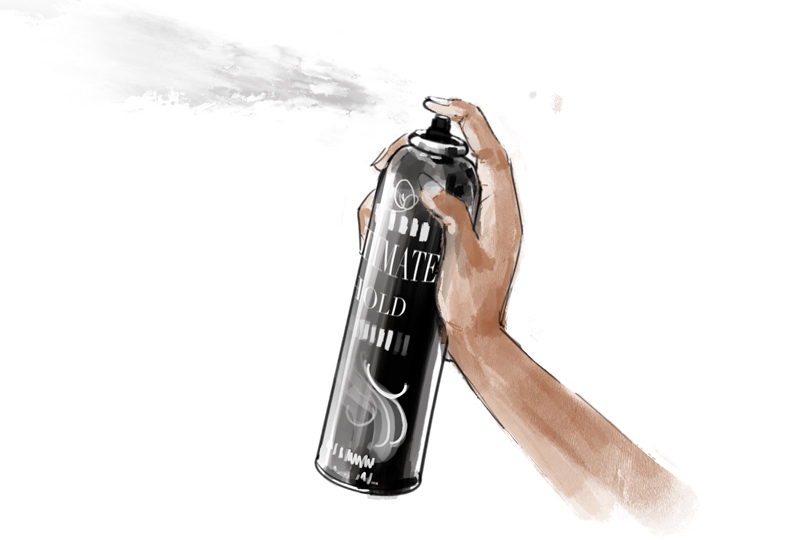
Illustration by Michael Hak
Hairspray is one of the most widely used and beloved beauty products around the world…an essential tool for anyone wanting to create and perfect a more sculpted hairstyle, from the lacquered coiffures of mid-century glamour to the gravity-defying volume of the 1980s. Hairspray is more than a simple finishing product; it reflects and holds our changing ideas about beauty, allowing style to last—and meaning to take hold.
Prior to the invention of hairspray, there were a variety of setting lotions and pomades that were designed to keep hair in place after styling, but hairspray as we know it didn’t arrive until the 1940s, when the first patents describing copolymers for hair styling were published. These patents came as aerosol spray cans (which had been developed decades earlier) were being redeveloped and famously used to distribute insect spray among the military in an attempt to stop the spread of malaria during World War II. Surprisingly, something that had originally been developed to fight a deadly disease quickly transformed into a global staple for perfectly coiffed hair in personal care routines. In fact, by 1964 hairspray had become the highest-selling beauty product in North America—even outselling lipstick—as sky-high structured hairstyles like the beehive became popular.
To say that hairspray revolutionized the hair industry would be an understatement.
So, how was hairspray actually developed, and how did it go from a basic styling tool to an essential finishing product of so many beauty routines? Read on for the fascinating history of hairspray, including its invention, how it has reflected shifting ideas surrounding femininity, and how it became a beauty icon that’s still going strong today.
Hairstyling before the invention of aerosol
Hair has always carried enormous social weight, and over the centuries women (and men) used a variety of different products, combined with tools like heated curling irons, pins, combs and padding, to create a little volume with their hair.
In ancient Rome, natural hairstyles were considered barbaric, and implied a lack of both wealth and taste, so it was common for Roman noblewomen to have complex, unnatural hairstyles that required hours of attention from slave hairdressers called ornatrice. These hairdressers, and their assistants, would twist, braid, curl and tease the woman’s hair before tying it with cords or ribbons to bind around the head. Hair would then be stitched up with a blunt bone needle and wool thread, and held in place with wire, hairpins, combs and hairnets made of finely woven gold wire. For even more hold, they used beeswax, the only styling product available at the time—the closest thing to hairspray they had.
Centuries later, some Victorian women continued to use beeswax, as well as pomades, oils, brilliantines and tonics to add sheen to their hair and, more importantly, hold their locks stiffly in place. There were also shellacked homemade solutions of sugar water, gelatin or soap flakes that held elaborate updos in place, but the most popular hairstyling product of the time was a clear gum solution known as bandoline, which came from gum arabic. Liquid bandoline could be purchased at most Victorian perfumers, but it could also be made at home from ingredients like quince-seed, rose-water, cologne, and spirits such as rum or brandy.
Godey’s Lady’s Book, America’s leading 19th-century women’s magazine (which was published between 1830 and 1989), explained in its 1859 edition: “In some peculiar temperaments there is great difficulty of keeping the hair in its place on account of its fineness. This is especially provoking when, in the ball-room or dance, the hair becomes disordered from the least exercise; a mucilage prepared by boiling a few quince-seeds in water, till of a glutinous consistence, will in general remedy this defect.”
Hair in this era was not just decoration; it was conformity. Control implied respectability, and stray hairs, like stray women, were suspect. That idea would survive well into the 20th century—and hairspray would cement that attitude.
The birth of the aerosol era
The first aerosol can was patented in the United States by Norwegian engineer and inventor Erik Rotheim on November 23, 1927. But while Rotheim invented the concept of a propellant system that could hold and subsequently distribute desired content from its metal can through an attached valve apparatus, it was the U.S. military’s need for portable insecticide during World War II that spurred the development of the modern aerosol can. In 1941, Lyle Goodhue and William Sullivan of the U.S. Department of Agriculture expanded on Rotheim’s invention and developed a pressurized aerosol can (known as the “bug bomb”) that could be used to distribute insecticide among the military in an attempt to prevent malaria, making the technology practical and paving the way for widespread consumer products, including hairspray, after the war.
There is evidence that shows early forms of hairspray were being experimented with in Europe in the 1920s, but hairspray as we know it rode the wave of postwar optimism that arose in the late 1940s. The first patents describing copolymers for hair styling were published in the first half of the 1940s, and by the time the war ended in 1945, the beauty industry was already exploring the possibilities of using aerosol cans as a dispenser for the first sticky, hard-hold, resin-based versions of hairspray. Hairspray entered domestic life at a time when women were being encouraged to model stability, polish and restraint. Hair was not meant to look laboured—even if it required considerable labour to achieve a controlled hairdo—and the introduction of a commercial hairspray made that possible.
Chase Products, an aerosol manufacturer that had been established in 1927, adapted the technology for hair and became the first manufacturer to package hairspray when they released a resin-based spray called “Spray Net” in the United States in 1948. Beauty titan Helene Curtis is credited with coining the generic term “hairspray” two years later, in 1950, as the best-selling Spray Net product began being mass produced. Spray Net was an immediate success and became the first commercially successful hairspray in history, becoming a household name alongside competitor Aqua Net, which had entered the marketplace shortly after.
Spray Net and other early hairsprays were stiff, unforgiving and unapologetically synthetic. They did not suggest movement or softness—not surprising, considering early formulas often used shellac, a resin secreted by female Kerria lacca bugs.
Fun fact: Many of the early hairsprays followed Spray Net’s lead and included the word “net” in their name, because they acted like a hairnet holding hair in place.
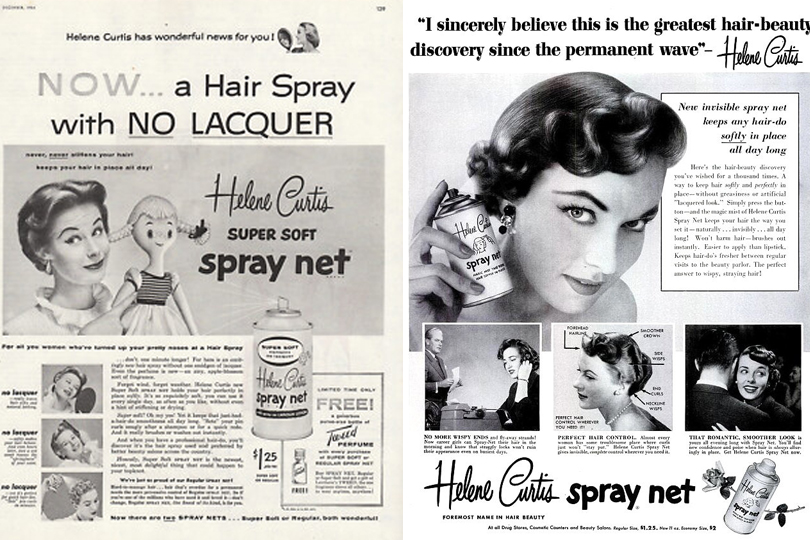
By the late 1950s and early 1960s, as hairstyles grew taller and more “architectural,” with gigantic bouffants, updos and beehives becoming increasingly popular, heavy-duty hold hairsprays became less a finishing touch than a structural necessity. By 1964, Spray Net, which was being mass-produced across the U.S., was the highest-selling beauty product on the market, “outselling even lipstick,” according to Victoria Sherrow’s 1996 book The Encyclopedia of Hair. Along with commercial success, the 1960s saw new nuances in products, including varying levels of hold and sprays aimed at different hair types and textures—the first precursors for the endless selection of sprays one can find in drugstores and professional hair salons today.
In the 1970s, hairspray use began to decline as hairstyles became more relaxed, predominantly being worn straight rather than curled, and flowing freely rather than being tightly controlled. As well, the beauty industry’s magic spray lacquer suffered a few setbacks, such as the discovery that some of the ingredients used were said to harm both the environment and women’s health.
Have you heard of CFCs? Prior to 1979, the most popular propellants used in hairsprays were CFCs (chlorofluorocarbons), which could also be found in refrigerators and air conditioners. In the 1970s, scientists discovered that CFCs were rapidly depleting the ozone layer, and that discovery provoked new environmental regulations that forced manufacturers to phase out their use of CFCs. Hairspray distributors therefore had to abandon CFC technology in favour of “alternative propellants and mechanical pump sprays,” according to The Encyclopedia of Hair.
In just 10 years, beauty companies made adjustments to the formula of their hairsprays to remove these harmful ingredients, and the product took off again in the 1980s…just in time for the “bigger is better” hair trends of glam metal and punk rock. New propellants were introduced, and brands like Aqua Net and Rave became synonymous with the era’s signature voluminous looks.
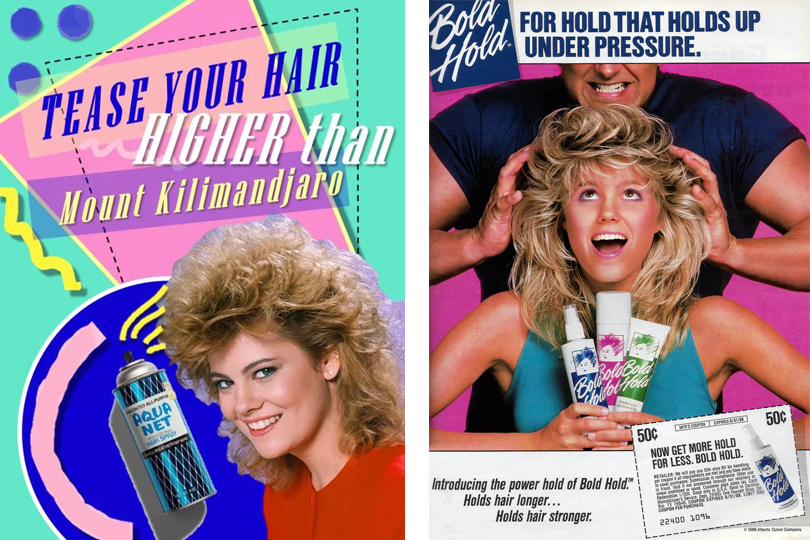
So, how is hairspray made?
While some things have changed since the invention of hairspray in 1948, hairsprays are still made with the same key ingredients: polymers (holding agents), solvents, additives and propellants.
Polymers are what hold the hair together. Today, different kinds of polymers are used for varying strengths and holds. Solvents are the carriers of hairspray’s active ingredients, while additives help the texture of hairspray (the ultimate hairspray feels like you aren’t wearing any) and keep the inside of the container from rusting. Finally, propellants are what get the hairspray out of the aerosol can and onto your head. (This is where those CFCs used to come into play.) Once a propellant leaves the aerosol can, it evaporates into the air. Today, propane and butane are often used, which are found in the gaseous form of petroleum.
The politics of hair
The late 1950s and early 1960s will always be identified with hairspray thanks in part to Hairspray, the lighthearted 1988 John Waters film that was made into a hugely successful, Tony Award-winning Broadway musical in 2002. The film was notably remade again as a musical film in 2007 with Nikki Blonsky and John Travolta, along with Zac Efron, Michelle Pfeiffer and Queen Latifah.
In both the films and the musical, hairspray is both a central plot device and a symbol of the 1960s setting.
Set in early-1960s Baltimore, the story centres around Tracy Turnblad, a plus-size teen who dreams of dancing on a local TV show and ends up challenging racial segregation in the process. Of course, in Waters’ world, hair is never just hair: it’s status, aspiration and defiance. Hairspray plays a starring role in the story that goes far beyond Ultra-Clutch Hairspray, the company sponsoring The Corny Collins Show, the fictional TV dance program that Tracy dreams of joining.
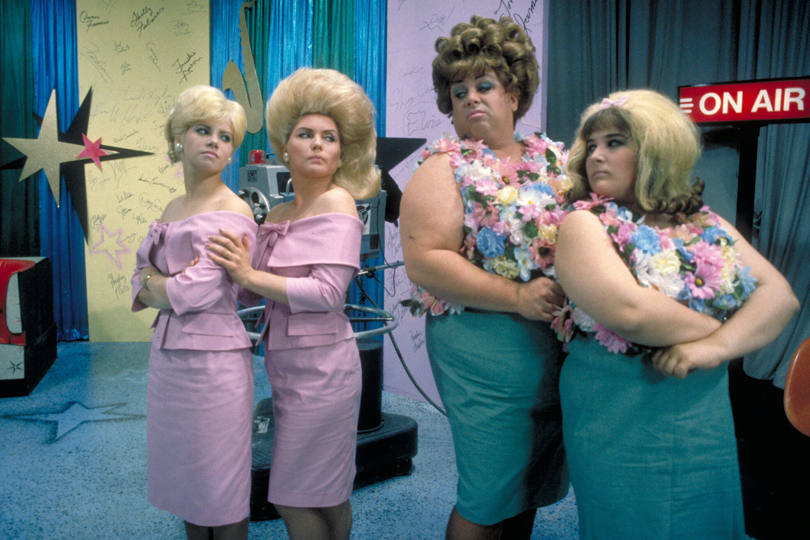
For Waters, the famous hair product represented an entire generation, and Hairspray ultimately uses hair not simply as background detail but as a narrative device throughout the film. The sprayed styles worn by its characters signal aspiration, exclusion and resistance long before any dialogue does, and even signal who belonged on television…and who didn’t.
Still holding
Today’s beauty landscape is more fragmented than the 1960s, but the obsession with hair control remains. Hairsprays have evolved significantly from their sticky predecessors, thanks to years of reformulations, and there are endless options to choose from. Manufacturers offer a wide range of formulas with different levels of hold (flexible, medium and maximum), shine and humidity resistance, while still offering up movement, touchability and softness. Modern innovations include alcohol-free and brushable formulas that provide hold without stiffness, catering to diverse hair types and styling preferences.
The options are seemingly endless and make you wonder… Who could have predicted that a wartime campaign against a deadly disease would be responsible for decades of perfectly coiffed hair?

Want more? You can read other stories from our The Story Of series right here.