
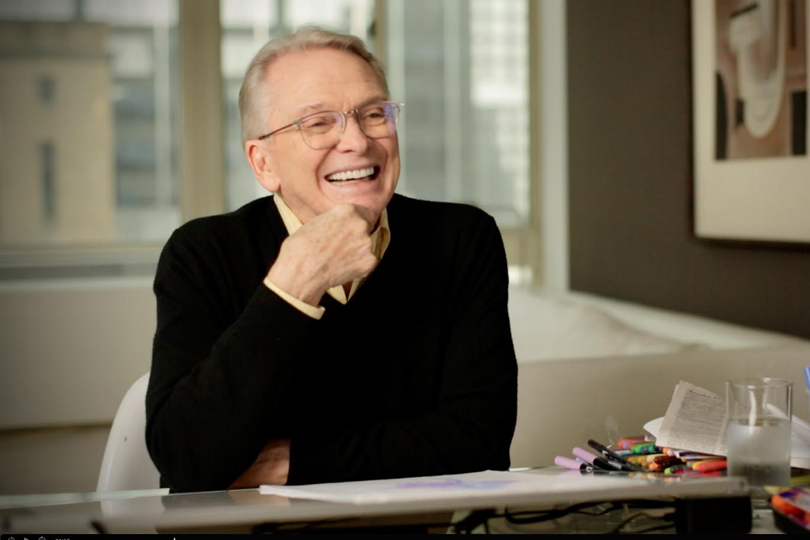
An exclusive interview with the master of glamour on six decades of sequins, showgirls, spectacle and BDE (Big Diva Energy).
By Elio Iannacci
Edited by Christopher Turner
Photos by Darrin Noble

There has to be a divine reason why fashion designer Bob Mackie was born on March 24. The internet-nicknamed “diva week,” a stretch of days around his birthday, reads like a stellar concert lineup, stacked with the most influential voices—and iconic style makers—in entertainment. Mackie’s own birthday sits squarely in the middle of them all: from R&B legends Stephanie Mills (born March 22) and Chaka Khan (March 23), through soul, jazz, pop and country monarchs such as Aretha Franklin and Elton John (both March 25), Diana Ross (March 26), Mariah Carey, Fergie and Sarah Vaughan (March 27), Lady Gaga and Reba McEntire (March 28), Astrud Gilberto (March 29) and, finally, Céline Dion (March 30).
It’s fitting that Mackie—who turns 87 this year—made his own debut among the great Aries dames and the iconic names he’s dressed (he’s costumed eight of the 12 mentioned). In Hollywood circles, Mackie is known as the Queen Maker: his designs defy trends and conventional tastes, amplifying, deifying and sometimes redefining the persona of anyone who wears them. His star-studded 2024 documentary, Bob Mackie: Naked Illusion—a must-see for any fashion fan—confirmed that a Mackie gown is more than fashion. It’s a crown and scepter for those who deserve it, a rite of passage for rising stars like Miley Cyrus and Zendaya, who have turned away from Parisian couturiers to elevate themselves through his work for major appearances. It’s also a proven comeback tool for legends such as Judy Garland, Tina Turner and Cher. Most recently, Sabrina Carpenter tapped into Mackie’s archive at the 2025 MTV Awards, wearing three vintage looks to channel pure, retro joy—because with Mackie, you don’t just wear a dress; you ascend.
Mackie at home
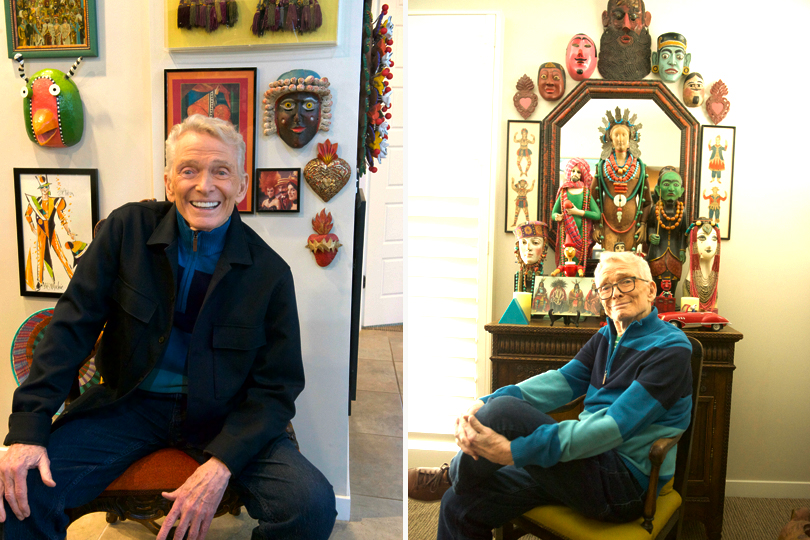
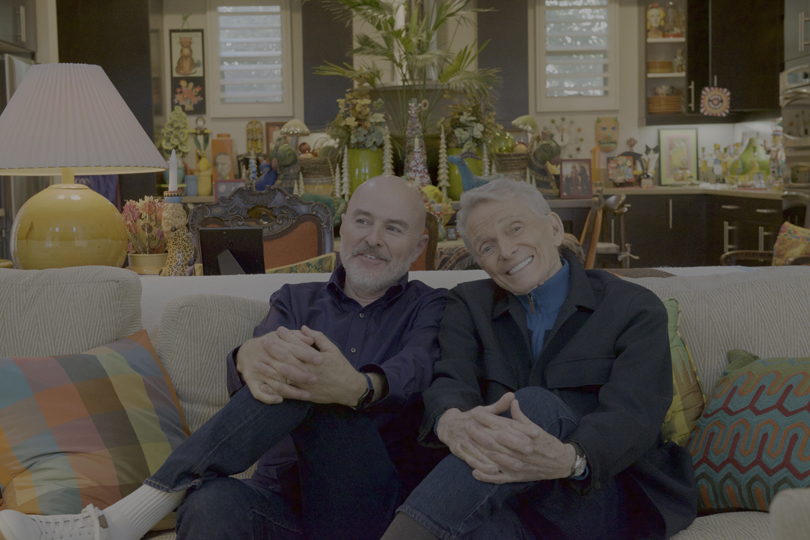
In person, at his home in Palm Springs, he waves off the crown title and any compliments and repeatedly says things like “I’ve been lucky” or “I won the lottery” while showing me and the three-man crew around his place. On that crew is decorated LA artist John Parot, who agreed to step out of his studio to step in as art director on set simply to witness Mackie’s magic in person. Also on hand is Mackie’s long-time design director, Joe McFate, who has been working with him for more than 20 years. While photographer Darrin Noble roams around the sunny living spaces, he points to a number of Mackie’s own hand-drawn sketches hanging amoung Indigenous, Greco-Roman and East and West Asian art and artifacts. When probed about the influence on the walls that have leapt from the gallery into his silhouettes, Mackie pours the three of us a cocktail of pride and humility, stating: “Looking back, I do feel that I achieved my own dream in my own way. As a kid, I simply wanted to see and be part of a place where art was alive, and I thought the glamorous world I saw in movies—when I watched stars like Betty Grable—was so exciting and where I belonged. Later in life I was able to find myself right in the middle of it—the glitz and the art—and this house is a testament to what I try to make.”
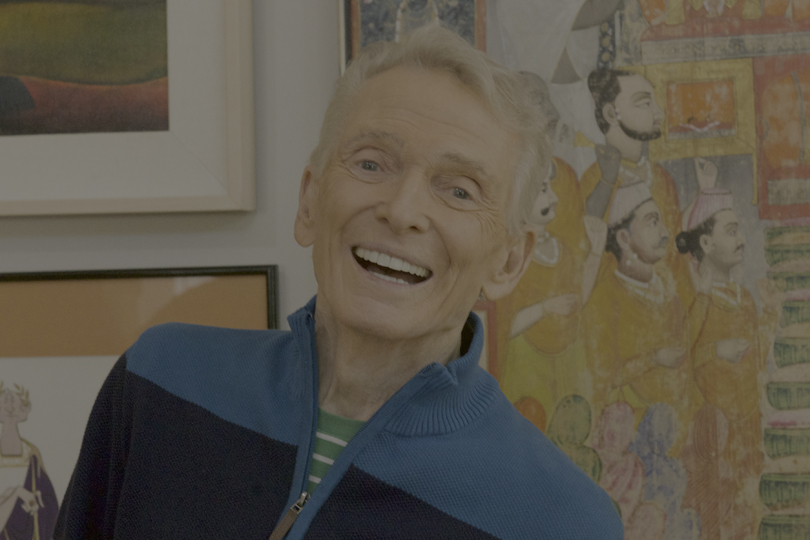
Small tables hold paintings, photos, notes and memorabilia from his world travels; above his couch hangs an unmissable portrait he did of the Pointer Sisters wearing a vibrant, slitted ’70s-spiked Harlem Renaissance dress combo. In the washroom, a tender portrait of Judy Garland, refined with coloured pencils, is framed inches away from the shower. In the kitchen, small framed photos of Cher in different eras poke out of the cupboards. The powder room holds incredible photos of celebs (Liz Taylor, Liza Minnelli, Mitzi Gaynor) and young Bob in various stages of his career, looking as confident and as movie star-like as all the blond hunks of today: eyes as intense as Chris Pine, a flashy smile that rivals Liam Hemsworth’s and twinky dimples that resemble Troye Sivan.
The rest of the wall space is dedicated to all of the things he loves: art, music, fashion, film, and a select group of books curated in front of a large ottoman in the living room.
Designer to the stars
As we start chit-chatting, he picks up a big tome and flicks to a familiar image: Marilyn Monroe in the epic “Happy Birthday” dress she wore in 1962 for then-President John F. Kennedy—which Mackie sketched and co-designed with French-American costumer Jean Louis at the age of 25.
“Can you believe all that? I still can’t,” he says. And “all that” is public record. Mackie’s breakthrough with Monroe wasn’t just fashion—it was full-blown American scandal. He rendered the rhinestone-studded nude illusion so perfectly that it exploded across headlines in 1962, reportedly prompting Fox studio’s conservative executives to drop Monroe from their star roster just days later. The reason? The bombshell debuted it at a Democratic fundraiser, crooning a sultry “Happy Birthday” to her alleged lover, US president John F. Kennedy. The image was instantly plastered in tabloids and newspapers worldwide—turning her into the era’s most dazzling “Other Woman,” a rhinestone-clad femme fatale whose audacity captivated a judgmental public.
Sixty years later, the gown found new life when Kim Kardashian miraculously secured it on loan for the 2022 Met Gala. Of that second coming, Mackie remains a little more detached; he doesn’t quite throw shade, but implies a touch of shadow in his answer. “I’ll just be kind and say that what happened with her,” talking about the reality TV savant, “well, that wasn’t quite what we were originally going for and leave it at that,” he deadpans before moving on to another topic. “Not every style is for everybody. I’ve learned that the hard way,” he laughs.
Monroe—whose gigantic monument in Palm Springs is blocks away from his home—would end up being the first of many legends that Mackie would go on to work with over his long career. Yet his next big name would come with more than just an opportunity or a boldface name: it was a life change.
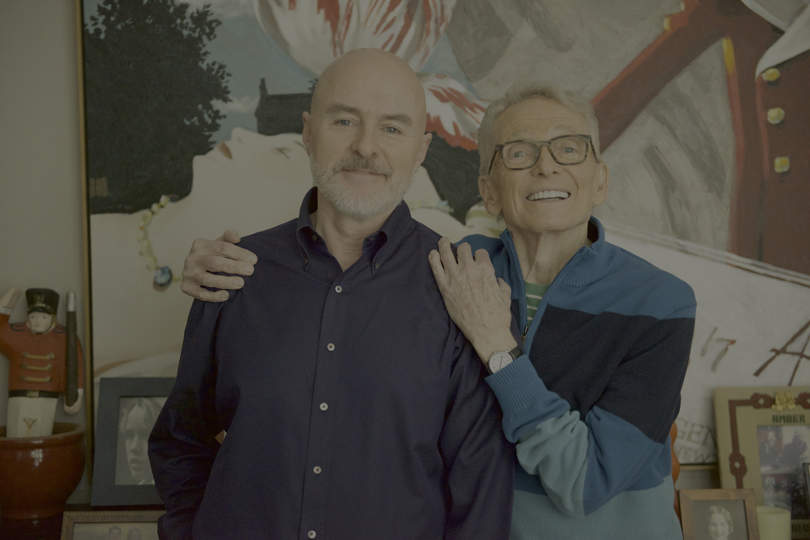
Through Iranian-American costumer Ray Aghayan, Mackie found himself working with someone Jake Shears of the Scissor Sisters once called “the Jesus Christ of divas”: Judy Garland. At the time, Mackie was in his 20s and already married to actress Lulu Porter, but he knew after meeting Aghayan: he divorced Porter and came out of the closet after realizing that he and Aghayan were in love. In many ways, the early clothes they made were love letters to themselves, a mishmash and an edit of their personalities and tastes.
“Sometimes he liked everything lavish, fur- or marigold-trimmed…a lot of decorated patterns…. It was all because of his background,” Mackie remembers. “When I first met him, I thought he was still sitting in the 1950s because he was doing so many Doris Day movies, so things looked really rigid.… His mother was a couturier in Iran, so there was so much Persian inspiration in his clothes.… He loved exoticness—it wasn’t exotic to him, though. At the same time, he was pushed to try to do what everybody wanted those women to look like on television in those days. Then, I came along and put an end to that.”
A partner in design…and in life
Aghayan’s first major dress design was for Princess Fawzia of Egypt, who became Queen of Iran as the first wife of Mohammad Reza Pahlavi, Shah of Iran. Unlike Mackie’s Americana-fuelled visions, Aghayan’s aesthetic was informed by stylish Middle Eastern women of the 1950s and ’60s—sheer fabrics, body-skimming shapes that celebrated the belly, blasts of colour, mesh, coins, zig-zag embroidery, paisley, statement jewellery, veils, and the great contrast between village girls’ intricate needlework and diplomats’ layered silks and noble crests. Growing up, Aghayan had developed his eye by studying the elegance of Empress Farah Pahlavi (third wife of the shah), often called the Jackie Kennedy of the Middle East, as well as the looks of pop icon Googoosh, whose bold, liberated style reflected a fleeting era of cultural freedom.
Designing together with Mackie was a constant cross-cultural dialogue and debate. “I was very honest with Ray about his work, and he was with me. If he showed me something for a show and I didn’t like it, I would say so directly. I would tell him, ‘Don’t do that—it looks like 10 years ago. Do something more real, more today,’” Mackie says, after noting his reason for his sometimes-harsh honesty. “Fashion was changing at that time, and you didn’t want something that looked like the 1950s housewife when everything was changing.” The change was doing both women and fashion a load of good. While women’s rights groups were taking action, the ’60s brought on looser, less constricted and less matronly silhouettes. Even cocktail and evening wear began to sprout into something beyond ornamental and functional: clothes were becoming symbols of grace and self-sovereignty in a Mad Men-esque world.
Mackie’s own visual education sprang from the desire to accentuate and liberate. For the most part, his mood boards were snatched from scenes in Golden Age movies and from the constellation of stars that lit them. So much of Hollywood, both past and present, motivated his early sketches (“I knew all the names of the big celebrities going up and down in popularity,” he tells me, “like I was betting on horses”). Mackie noticed something changed when he began to realize that beyond the beauty of the silver screen was something just as captivating—the underground.
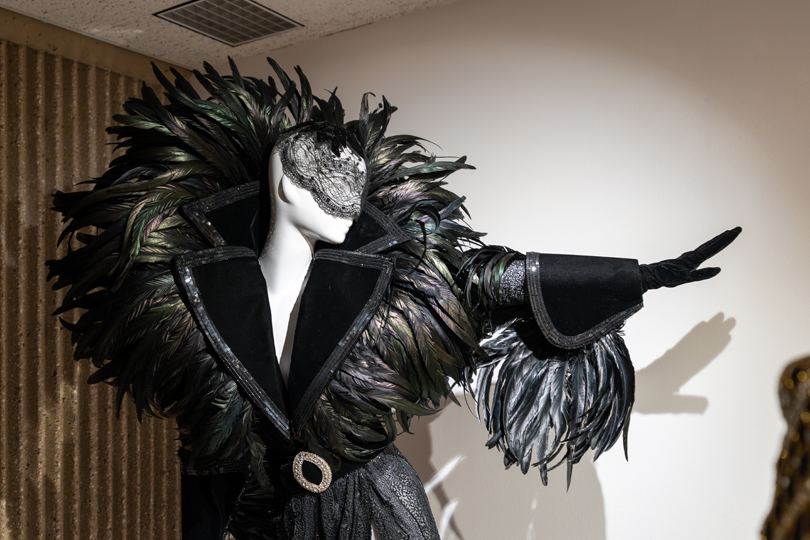
“It started when I was 17; I went to a burlesque show in downtown Los Angeles. The place was half empty, and there were all these old guys with their newspapers in their laps.” Then the well-known strip-sensation known as Tempest Storm walked onstage. “I was excited. She had bright red hair and wore all these pastel colours, and she was really something. I was so inspired.” You could see how burlesque influences were woven into so many of Mackie’s greatest hits just by wandering through a recent exhibit at the Palm Springs Art Museum, “Bob Mackie, Reflections on Glamour,” which curates sketches and clothing ranging from Madonna’s 1991 Oscar appearance (where she sang “Sooner or Later”) to RuPaul’s famous body suit for MAC’s now epic VIVA GLAM campaign.
But back to Judy Garland. When Aghayan and Mackie worked with her on her TV comeback in 1963, things weren’t quite as spicy; Mackie was soaking up lessons from his now-partner’s extensive experience. “Ray taught me that before the star even sings a note or says anything, their entrance needs to wow the audience,” Mackie tells me. The Judy Garland Show, a TV variety series, would feature other icons such as Barbra Streisand, Lena Horne, Ethel Merman, Peggy Lee, and a 17-year-old Liza Minnelli. In fact, both Aghayan and Mackie were taking steps toward a new day in design—and they were taking their clients along for the ride.
For example, Garland was used to the film studios telling her what to wear and how to wear it, because she’d been a child star with little autonomy. With Aghayan and Mackie, she not only had a say, but the threesome became closer than Mackie would ever imagine. “Judy had spent years at MGM wearing clothes she didn’t want to wear, so when we changed her look, she didn’t give me any trouble at all,” Mackie recalls. “She was used to other people deciding what she would wear. She appreciated being part of the conversation finally, and she liked Ray very much. The two of them got along extremely well.”
“Ray and I were often invited to Judy’s house on Sunday nights because her show aired on Sundays. I got the feeling she didn’t have very many friends she could count on and was very lonely, so I was more than happy to step in,” he says. “We would watch television with her, sometimes her show and sometimes The Ed Sullivan Show. If we were watching something she had just done, we usually didn’t critique it much—she might simply say someone looked great or that the clothes looked good.”
The duo went on to work together on a multitude of projects, but what many people don’t know is that both Mackie and Aghayan were the first people in history to ever win an Emmy for costume design (in 1965, for Danny Thomas’ The Wonderful World of Burlesque: Second Edition). What followed were collabs on Lady Sings The Blues with Diana Ross in 1972, and Funny Lady with Barbra Streisand in 1975. Between all that, the amount of work coming through the office was too much for the two of them to tackle together—so at some point, Mackie ended up taking on The Carol Burnett Show, which ran from 1967 to 1978, where he designed more than 17,000 costumes for the comedienne and her cast.
Finding Cher—his Soror Maxima
While all that was going on, Mackie met what most fashion historians would call his Soror Maxima (aka divine or greatest sister)—the person whose presence seemed to exemplify his designs and his aesthetic expression most fully. And that was a woman named Cher. She happened to be a guest on Burnett’s ratings juggernaut, and during her fitting with Mackie, she saw his range right away.
“Bob could design a beautiful gown and then turn around and do insane character costumes,” Cher wrote in her 2024 memoir. It was Mackie’s comic, fabric-heavy parody of Norma Desmond for Burnett’s now-famous Sunset Boulevard spoof sketch that immediately told Cher he was the right designer for her next career jump.
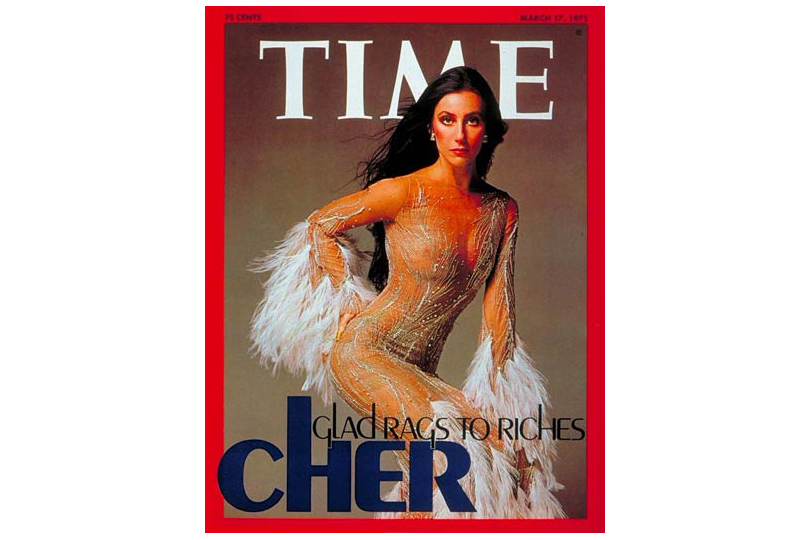
It was during the period when Cher decided to divorce Sonny Bono (her partner in both life and business) that Mackie created the now-famous Time magazine dress—which Cher wore for the magazine’s March 17, 1975, issue. It wasn’t the usual newsy portrait: a reportage-heavy war image, a natural disaster or a diet-scam exposé. It was Cher. Not Cher from Sonny and Cher, but a new, post-separation Cher, wearing a nearly nude, feather-accented white lace dress adorned with appliquéd branches and pearls. Conservative critics labelled it indecent. The dress wasn’t even supposed to be for the magazine’s cover; it was worn at the Met Ball and originally photographed for a Vogue shoot by Richard Avedon. Cher devotees mark the moment as a turning point: newly divorced from Sonny Bono, she shuttered The Sonny & Cher Comedy Hour and launched The Cher Show the same month the magazine hit newsstands—two seismic career shifts, back to back.
Aside from causing a worldwide shortage of Swarovski crystals, Mackie was also working on a plethora of costumes for Cher on her solo TV series (TikTok has hundreds of Wonder Woman–esque reveal clips that collate her seemingly endless outfit changes and twirls on stage). In Mackie, Cher found not only a sharp eye but a defender of their shared vision.
In person, Mackie tells me about the hours he wasted outside the atelier fighting with censors about what Cher could wear on her latter show. “When she was married, they left us alone,” Mackie explains. “As soon as she didn’t have a husband, then the concerns came about how much belly button we could show, how low the cleavage was—it was all nonsense. Cher wanted to look sexy; she’d just had a breakup and had a stunning body that she wanted to show off.”
Around the same time, Mackie was also working with Tina Turner, who was also reinventing herself after being in a controlling, abusive relationship with her husband, with whom she formed the famous Ike and Tina Turner duo. “They looked like revenge dresses,” Mackie proudly says of both Cher’s Time cover look and Turner’s now famed, circa-1975 flame dress (which showed off her legs and echoed the vision of a Phoenix rising).
“These dresses were speaking to their exes and saying, ‘Take a look, this is who I am now and you’re not going to get any more of this,’” Cher previously said.
Over time, it became clear how the design dialogue between Cher, Mackie and Aghayan evolved as Cher grew into her own as an artist. At first, Cher called the process as “being a hanger.” Mackie explains that there was an exploration period that merged into full collaboration: “The two of us [Cher and Mackie] were soon coming up with ideas together, with Cher explaining how she wanted to be seen or what she wanted to express through her clothes.”
The transformation reached its apex at the 58th Academy Awards in 1986. Cher had been snubbed by the Oscar committee for her performance in Mask, a searing, critically praised turn as a drug-addled single mother raising a teenage son whose face was grotesquely deformed by a rare genetic disorder. Instead of a nomination, she was asked to hand out a trophy. Furious, she called Mackie and plotted her sartorial vengeance.
“It was a big fuck you to the Academy,” Cher told me in Malibu, discussing her 25th studio album, Closer To The Truth. “They didn’t want to take me seriously, so we took matters into our own hands.” That “we” was Mackie—who, following Cher’s vision, dreamed up a black, midriff-baring, jewel-encrusted two-piece: a low-rise skirt, thigh-high boots, an embroidered shawl and a towering feather mohawk headpiece.
“Cher and I were already starting to make her out to be a warrior goddess—not an average person—and sometimes I made her a showgirl from hell,” Mackie remembers. “The famous Oscar outfit that Cher wore was essentially a big statement against the industry. At that time, people in Hollywood didn’t take her seriously when she dressed in those dramatic, theatrical ways. Some people loved it and some people hated it, but she had reached a point where she didn’t care anymore. She had already done films like Silkwood and Mask where she played more ordinary women, and she had also done Broadway, so she had proven herself in different ways.… That outfit became a kind of defiant moment—her way of saying she wasn’t going to dress the way the industry expected her to.”
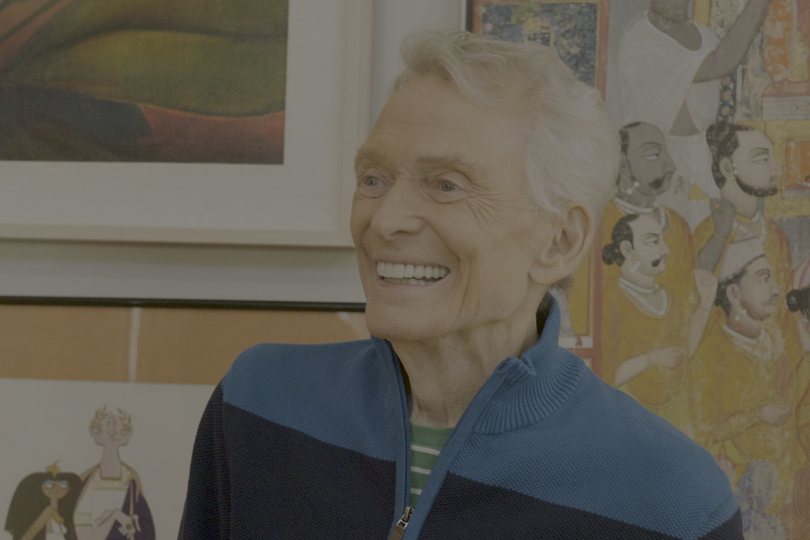
For her Oscar-winning statement for her work in Moonstruck in 1988, there would be another message to Mackie’s look. “Well, first we wanted people to look and know they wouldn’t see that kind of woman every day,” Mackie tells me. “Then there was the fact that she thought she wasn’t [going to win again] and feeling like she wasn’t being acknowledged for her work, and I could relate.… People kept saying, ‘Well, that’s not fashion,’ when it came to what I made for her. They wanted her very ladylike, and she’s not that so we never went there.”
His design—and many others that followed for her—was a vocabulary of status-quo crushing accents, a rebellion against what was considered appropriate at the time for Hollywood and the world. His fuel—the burlesque luminaries, MGM chorus girls, Old Hollywood vixens and Broadway flash—was in direct opposition to the names that Vogue magazine would highlight month after month. Mackie was the anti–Bill Blass (neutral-toned, understated separates), a counter to Anne Klein (menswear-fused work-and-sports attire), and a brash nemesis to Oscar de la Renta (high-society frocks).
A rebel against the standard
Because Mackie insisted on designing in his own lane, using materials that were performance-driven or detailed with stage- or film-enhancing pieces, he was shunned by the elite fashion flock of the 1970s, ’80s and ’90s. “Some people used to call me Barnum Bob or Mr. Show Business,” he says of the many disparaging names people had crowned him with. Yet, as his documentary of 2024 notes, people like Tom Ford ended up seeing Mackie as a hero whose work and worth was something “to absorb,” not critique. While the commercially embraced lot of American designers favoured a soft delicacy in their technique, Mackie extravagantly proclaimed his love of beading, feathers and shine, crafting silhouettes that were, in the eyes of those more commercially minded, too much, too extra and, perhaps, too gay.
For much of his career, the Council of Fashion Designers of America overlooked him, leaving it to 2019 before awarding him a lifetime achievement honour. And even after 58 years of designing costumes for Oscar-nominated films—including Pennies From Heaven, Funny Lady and Lady Sings the Blues—the Academy has never given him an Oscar. (Cher did share hers with him for Moonstruck in 1988, for which Mackie designed a jewel-encrusted, black-ink version of the naked dress).
Mackie went on to create another headline-snatching look for Cher a year later, which would be connected to yet another comeback—this time to the music charts. In her 1989 video for the rock-tinged love song “If I Could Turn Back Time,” Cher emerged from the USS Missouri—a historic World War II battleship—flanked by more than 200 screaming, testosterone-fuelled sailors…and Mackie instantly found himself in another scandal. The “seat belt outfit,” as Mackie calls it, was essentially two thick strips of fabric forming a pronounced thong-like V over her body, paired with a fishnet bodysuit. It showed so much of her ass (tattooed with a butterfly) that MTV refused to air the video before 9 pm. Yet nothing stopped the song from climbing the Billboard charts—not even the outraged veterans who petitioned for MTV to ban it outright.
A decade later, Mackie was there again in 1999, when Cher topped the charts with the dance hit “Believe”—becoming the oldest woman in history to reach #1. This was after 10 years without her having a single new recording played on top ten pop radio. For the video, Mackie conjured a Martian-meets-CEO look: an all-business, Dynasty’s Alexis Carrington look, but from another planet. The collaboration continued into what Cher called her Farewell Tour, a travelling retrospective spectacle that stretched on for nearly three years (to be honest, I’m not sure it’s actually over yet).
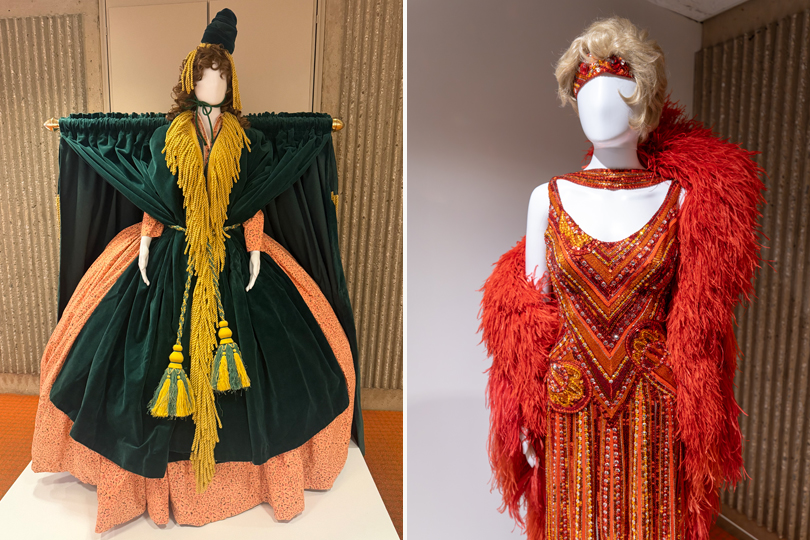
The tour began in 2002, and I was assigned to review it three times, in two different cities, as it ran through 2005. Looking back now at my archived notes, it’s striking how seamlessly Aghayan and Mackie’s visions overlapped across Cher’s five decades in show business: “Persian Versace Dolorosa meets Donna Summer Bad Girls,” “Robotic Paco Rabanne Bellydancer,” and “Alice in Wonderland meets Mad Max in India.” The writing sounds like pages ripped out of a script for Michael Kors on Project Runway (which Mackie also guested on—Season 6 in 2004).
It wasn’t obvious then, but the creative throupling of Mackie, Aghayan and Cher was embedded in the very patina of the costumes. Mackie’s influence continues to ripple across the globe and through popular culture. For Taylor Swift’s latest record-breaking album, The Life of a Showgirl, the billionaire pop star drew on archival pieces from Mackie’s costume pool—originally created for his 1981 work on the Las Vegas revue Jubilee!—with palettes based on the jewel tones of amethyst, sapphire, emerald and ruby. And his reach continues to expand beyond the stage: a travelling exhibition called Diva, featuring Mackie-designed costumes worn by Bette Midler, Pink and, of course, Cher, will move from the Australian Museum of Performing Arts this April to the Denver Art Museum this fall.
Yet no matter how many new singers tap into Mackie’s treasures, nothing quite matches the kismet he shared with Cher and with Aghayan, his partner of 50 years, who until his death in 2011 served as both Mackie’s professional collaborator and personal support system. Together, their visions unfolded as a limitless fantasy—cultures colliding, eras folding into one another. Cher wasn’t simply performing; she was carrying past lives and future dimensions on her back, wrapped in the devotion of two men who loved her, and loved each other.

Trending
 Here’s Every Song From ‘Love Story: John F. Kennedy Jr. & Carolyn Bessette’ [UPDATED]
  THE STORY OF: Elvis Presley’s Jet-Black Hair
  10 Memorable Images Of Supermodel Gia Carangi (1960–1986)
  A Look Back At Gia Carangi’s 5 Cosmopolitan Covers
  THE STORY OF: Carolyn Bessette-Kennedy’s Narciso Rodriguez Wedding Gown